Norddeutscher Lloyd: The Forgotten German Atlantic Giant
TL;DR — Between roughly 1897 and 1914, Norddeutscher Lloyd (NDL) of Bremen was the largest shipping line in the world by passenger volume and arguably the most visually accomplished line operating on the North Atlantic. Its 1901 watercolour cover programme — the “Harbour Scene” series and its sister cards — produced some of the strongest illustrated menu work of the entire Golden Age. The line was destroyed twice (1918, 1945), absorbed in 1970, and is now largely forgotten outside maritime-history specialist circles. This guide explains why it mattered and what survives.
The Line: Bremen, 1857–1914
Norddeutscher Lloyd (“North German Lloyd”) was founded in Bremen in 1857 as a joint-stock shipping line, with mail and emigrant contracts as its initial business. It expanded steadily through the 1860s and 1870s, took on the New York–Bremen Atlantic route as its core service, and by the early 1890s was a serious competitor to the British lines on the North Atlantic. The expansion that made it globally significant happened between 1897 and 1907 under a single ship-building programme that produced the express liners Kaiser Wilhelm der Grosse (1897), Deutschland (1900, a Hamburg-Amerika ship but commissioned in the same competitive moment), Kronprinz Wilhelm (1901), Kaiser Wilhelm II (1903), and Kronprinzessin Cecilie (1907).
The Kaiser Wilhelm der Grosse took the Blue Riband — the unofficial Atlantic speed record — from the British in 1897 and held it on and off through the next decade. This was a serious event in transatlantic commerce: the British had held the Blue Riband almost continuously since the mid-nineteenth century. The German lines’ arrival in the front rank was visible on every quay from Hoboken to Liverpool. NDL’s market share rose alongside the speed records; by 1907 the line carried more transatlantic passengers per year than any single British line.
The expansion was also visual. NDL invested heavily in the visible quality of its first-class experience: panelled saloons by named decorators, deck-house architecture by Bremen ship designers, and a menu cover programme commissioned from named watercolourists. This programme is the source of most of the major surviving Buttolph holdings for the line.
The Watercolour Cover Programme: 1897–1906
From around 1897, NDL began commissioning watercolour cover artists for its first-class dinner menus. This was a parallel programme to Hamburg-Amerika’s better-documented watercolour cover series; the two German lines pursued essentially the same visual strategy simultaneously, drawing from overlapping pools of Bremen and Hamburg artists, though each line maintained its own design identity (Finamore & Wood, 2017).
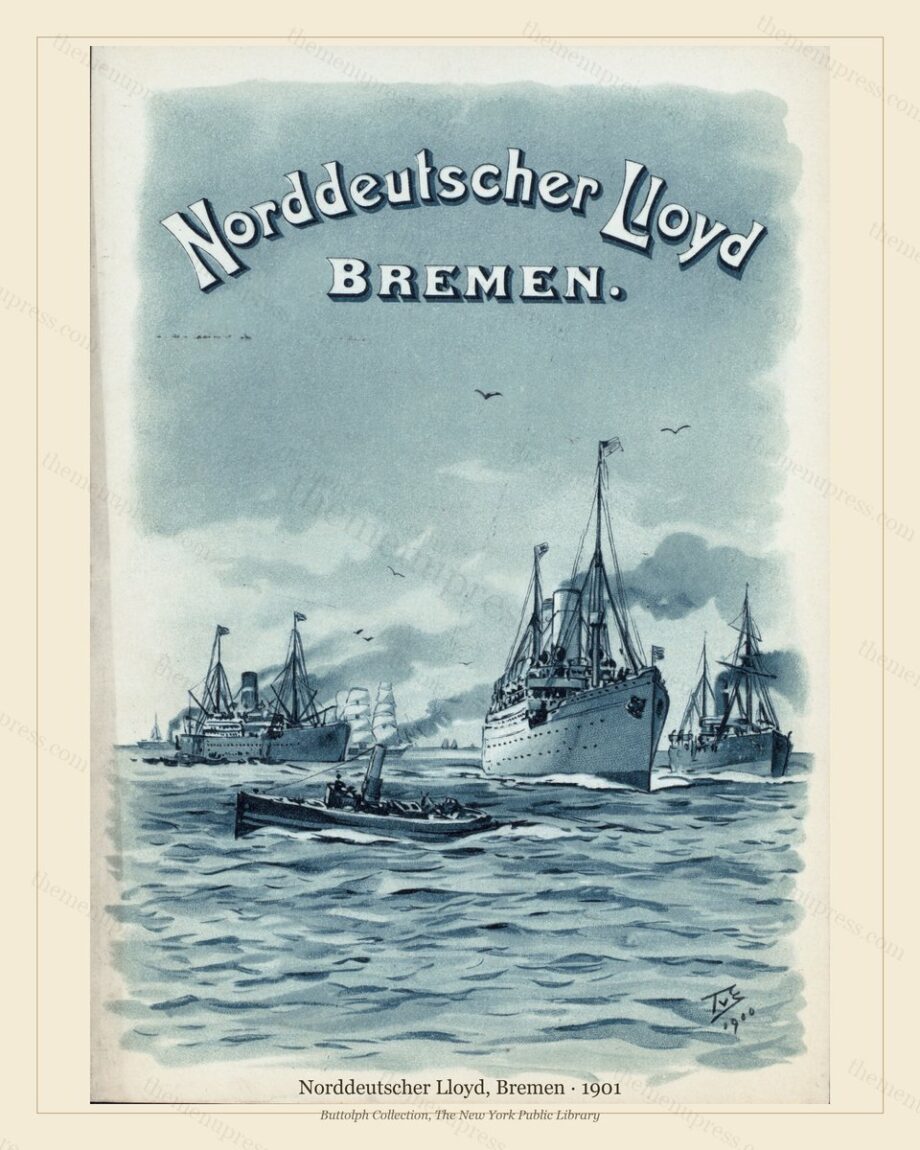
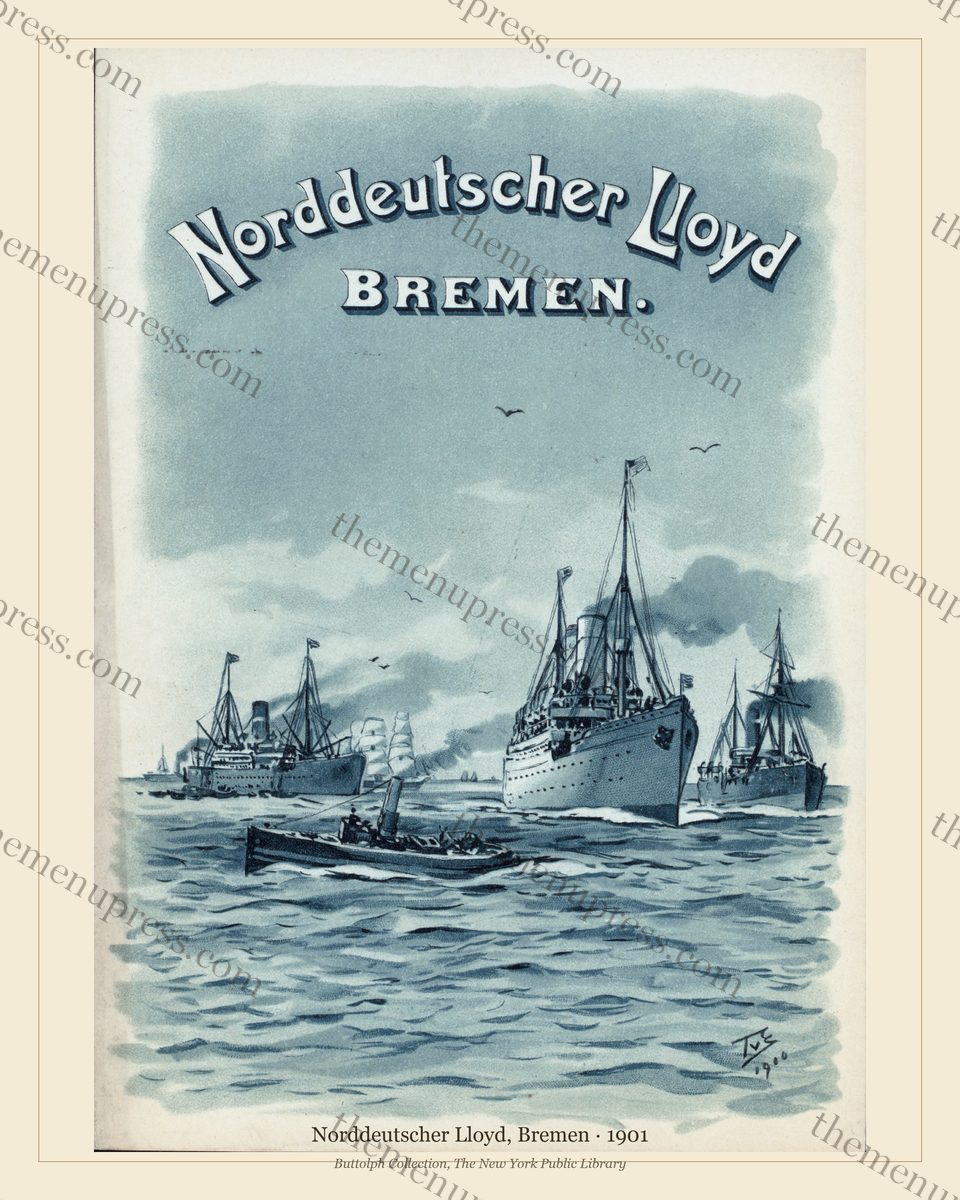
The NDL programme distinguished itself in subject matter. Where Hamburg-Amerika favoured ship portraits, allegorical figures, and abstract maritime motifs, NDL favoured landscape: harbour scenes, port views, lighthouses, coastal towns. The 1901 “Harbour Scene” card preserved in the Buttolph holdings — a signed watercolour of dawn light over the Weser at Bremerhaven, with the silhouette of a steamer at the quay — is the most reproduced example. It reads as a piece of Belle Époque landscape illustration that happens to also be a menu cover.
The technical execution was lithographic: typically four or five colour stones plus a key drawing, on uncoated card. The print runs were small — perhaps two to four thousand copies of each design — because the cards were used for a single crossing season and replaced. The result is that surviving copies of any individual NDL design are rare even in the Buttolph archive; the collection holds eight or nine NDL covers from this period in good condition, against perhaps a hundred Hamburg-Amerika covers of comparable quality. The German lines’ menu work is a small genre, but at its peak it competes with the era’s commercial poster art.
1914: The First Destruction
The First World War destroyed Norddeutscher Lloyd as a major North Atlantic operator. The line’s ships in American or British ports at the outbreak of hostilities in August 1914 were interned and seized as enemy assets. Ships at sea ran for neutral harbours and were either interned or eventually seized. By the time the war ended in November 1918, NDL had been stripped of essentially its entire ocean-going fleet under the Treaty of Versailles: Kaiser Wilhelm der Grosse, the Kronprinz, the Kaiser Wilhelm II, and the Kronprinzessin Cecilie were all gone.
Most of the seized German liners went to British and American operators — the Kaiser Wilhelm II became the Cunard’s Berengaria, the Imperator (Hamburg-Amerika) became the Berengaria as well (after intermediate ownership), and the Bismarck (also HAPAG) became the White Star Majestic. The pre-war German Atlantic fleet thus ended its career under British flag, mostly on the same routes, but stripped of the visual identity that had distinguished them.
1929 Comeback, 1945 Second Destruction
NDL rebuilt through the 1920s with a smaller fleet and recovered enough to launch the Bremen (1929) and Europa (1930) — two new express liners that briefly took the Blue Riband back from Cunard. The new ships were elegant late-1920s designs in the inter-war modernist register, and they produced an accomplished but small body of menu work in that idiom. This second-period NDL material is much less prominent in the Buttolph holdings (Buttolph died in 1924) and survives mostly in German maritime museum collections.
The Second World War destroyed the line a second time: the Bremen burned at her Bremerhaven berth in 1941, the Europa was seized by the Americans in 1945 and transferred to French ownership (where she ran as the Liberté until 1962), and the remaining smaller NDL fleet was largely destroyed in port. The line operated again from 1955 with rebuilt vessels but never returned to the front rank of Atlantic carriers. In 1970 NDL merged with Hamburg-Amerika — the historical competitor — to form Hapag-Lloyd, which continues today as a container shipping company.
Why NDL Is Now Forgotten
Three reasons. First, the line was destroyed twice in successive world wars: most of the fleet that defined it had been transferred to British, American, or French ownership by 1920, and most of the rebuilt fleet was lost by 1945. Material survivors are scarcer than for any other comparable line. Second, the eventual 1970 merger with Hamburg-Amerika reshaped the corporate identity into “Hapag-Lloyd,” which most modern observers associate exclusively with the Hamburg-Amerika side. Third, English-language popular maritime history has historically been written from the British perspective; the German lines appear as competitors in those narratives, not as protagonists, and their distinct identities blur together.
This is unjust to the visual work the line produced. The 1897–1906 NDL watercolour menu cover programme is, in absolute terms, peer work to the major French and British poster output of the same decade. It deserves to be remembered as a coherent design tradition, not as a footnote inside the larger “German Atlantic lines” category.
The Norddeutscher Lloyd cards in our archive represent the high-water 1884–1901 period: dinner cards from the pre-war express liners and the 1901 Harbour Scene programme that defined the line’s visual identity. They are catalogued individually and as part of the dedicated NDL Bremen bundle.
Frequently Asked Questions
What does Norddeutscher Lloyd mean?
“North German Lloyd” — a German joint-stock shipping company founded in Bremen in 1857. The “Lloyd” in the name refers to the shipping-insurance tradition originally associated with Lloyd’s of London and does not connect to any specific person of that name; it became a common designator for European shipping lines in the nineteenth century (compare Lloyd Triestino, Lloyd Italiano).
What’s the difference between NDL and Hamburg-Amerika?
Both were major German transatlantic lines; NDL operated from Bremen / Bremerhaven, Hamburg-Amerika (HAPAG) from Hamburg. NDL specialised in mail and passenger transport; Hamburg-Amerika had a stronger emigrant-traffic base in its earliest years and grew larger in absolute tonnage. The two lines competed directly through the 1890s and 1900s, pursued parallel watercolour menu cover programmes simultaneously, and eventually merged in 1970 to form Hapag-Lloyd.
Did NDL really hold the transatlantic speed record?
Yes — from 1897 the Kaiser Wilhelm der Grosse held the Blue Riband (the unofficial fastest-Atlantic-crossing trophy) intermittently, and several subsequent NDL express liners held or contested it through to 1907. This was the first sustained period since the mid-nineteenth century in which the British did not own the record. The 1929 Bremen took it back for Germany briefly before the inter-war French and Italian challengers.
Further Reading
- The Golden Age of Ocean Liner Dining 1880–1930
- Hamburg-Amerika Watercolour Menu Covers 1897–1906 (scheduled W6 Tue)
- How Imperial German Lines Beat the British at Table 1897–1914 (scheduled W15 Tue)
- Daniel Finamore & Ghislaine Wood, Ocean Liners: Glamour, Speed, and Style (V&A Publishing, 2017)