What First-Class Passengers Ate on a 1900s Transatlantic Crossing
TL;DR — A first-class dinner on a 1900-era transatlantic crossing ran eleven to fourteen courses across roughly two hours, in the Escoffier-codified French haute-cuisine tradition. Soup, fish in cream sauce, two entrées, a roast meat course, game in season, cold dishes, salad, dessert, a savoury, fruit, coffee, and an after-dinner cordial. By 1928 that programme had compressed to eight courses; by 1935 to six. This piece walks through the standard 1900 dinner course by course, with notes on what changed and why.
The Standard Programme: 1900
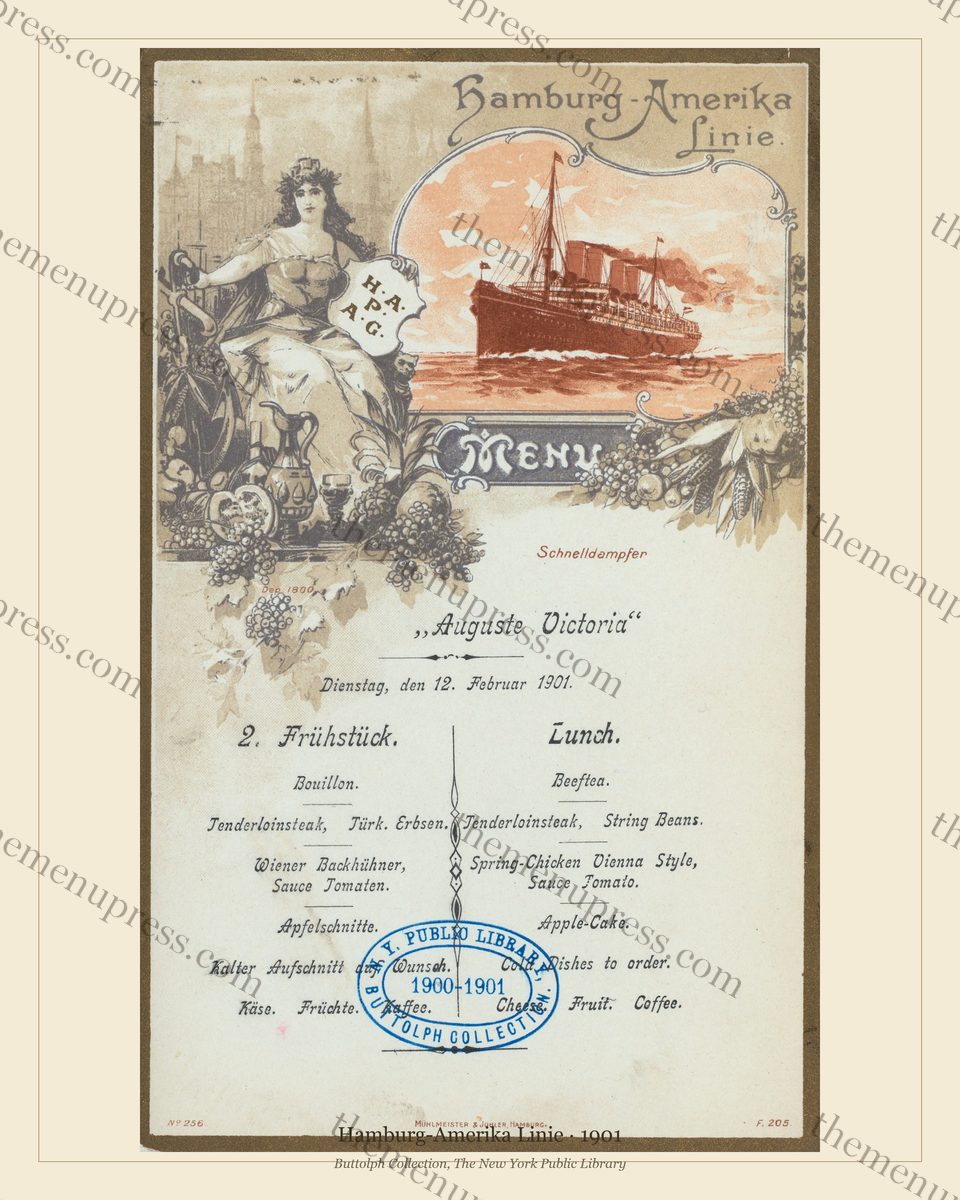
By 1900 the first-class dinner on the major transatlantic lines had standardised into a tightly coordinated French programme. Auguste Escoffier had codified the French saloon menu in the 1890s; the steamship lines adopted his model wholesale; the result was that a dinner card on the Lusitania, the Kaiser Wilhelm der Grosse, or the La Touraine in 1903 read in substantively the same structure even though the lines were British, German, and French respectively.
The standard programme ran eleven to fourteen courses across approximately two hours, with the courses delivered to the table in the prescribed order (the more egalitarian “service à la russe” rather than the older simultaneous family-table service). Each diner received each course; there was no choice within a course; the menu card was a programme, not a selection. What is striking to a modern reader is how little this resembles a modern restaurant dinner and how much it resembles a formal banquet.
Course by Course
- Hors-d’œuvres. A small cold plate: caviar, smoked salmon, small radishes, occasionally an olive selection. Served at table; eaten while champagne or a chilled sherry was poured.
- Soup. One clear consommé (consommé royale, consommé brunoise) and frequently one creamed alternative offered concurrently. The clear soup was the standard for the more formal table.
- Fish. Typically a poached or grilled white fish in a cream sauce: sole Mornay, turbot hollandaise, fillet of cod in shrimp sauce. A continental wine course shifted here from sherry to a dry white (a Chablis, a Moselle, a Pouilly).
- First entrée (relevé). A substantial course: a saddle of lamb, a fillet of beef, a galantine of duck. This was the dinner’s structural anchor.
- Second entrée (entrée proper). A lighter preparation: sweetbreads, a small ragout, quenelles of poultry. The contrast against the previous course was deliberate.
- Roast. A roasted meat or bird: roast lamb, roast chicken, roast pheasant. Served with seasonal vegetables and a gravy from the pan. By 1900 this course was often where the most substantial wine of the evening appeared (a claret, a burgundy).
- Game (when in season). An additional roasted course of game bird: partridge, grouse, quail, snipe. Served only between roughly August and February; omitted in the spring and summer crossings.
- Cold dishes. A platter of cold meats, foie gras, cold ham, occasionally a galantine. Often served buffet-style at the head of the table.
- Salad. A simple dressed green salad. The salad came late, between the cold dishes and the dessert, in the formal continental order — not at the beginning, in the American manner that would not standardise until the 1920s.
- Dessert. A pastry, a soufflé, an ice, a crème caramel. The dessert was usually a single composed dish rather than a selection.
- Savoury. A small hot savoury — an anchovy toast, a Welsh rarebit, devilled kidneys. The savoury was the diagnostically British feature of the Atlantic programme; the French menu omitted it. By the late 1920s this course had disappeared.
- Fruit and cheese. Cheese, dessert grapes, occasionally peaches or hot-house strawberries. Served with a fortified wine (port, madeira).
- Coffee. Black coffee, served in the smoking room rather than the saloon for the men; in the drawing room for the women. The dinner formally ended with the coffee service.
- Cordials. A separate after-dinner programme of liqueurs, cognac, and Armagnac, served in the public rooms after dinner. These were technically a separate event from the dinner itself but were part of the evening.
What This Looked Like in Practice
The first-class saloon on a major liner in 1903 sat 200 to 350 passengers. Dinner began at seven o’clock and the gong sounded at six-thirty for dress. Men wore black tie at minimum, white tie at the captain’s table; women wore evening dress with gloves. The orchestra played through the meal — a string quartet by 1900 standard, a six-piece small orchestra on the larger ships — from a gallery above the saloon.
The service operated to a fixed schedule. The kitchen had timed each course to land at the saloon door at the correct interval; the saloon stewards distributed the plates around the table on a tight rotation. Two hours from soup to coffee was the standard service time. The wines were paired to the courses by the wine steward; first-class passengers did not as a rule choose their wines individually unless they specifically requested otherwise.
The cost — embedded in the first-class fare, which in 1902 ran roughly £25 to £40 for a single one-way Atlantic crossing — was a fraction of what an equivalent dining programme on land would have cost (Maxtone-Graham, 1972). This was deliberate. The shipping lines used the saloon dinner as the visible expression of first-class quality, and they subsidised it accordingly from the fare.
How It Changed, 1910–1935
By 1928 the dinner programme had compressed to eight courses, in the new inter-war fashion. The hors-d’œuvres survived; the soup survived; the fish survived. The two entrées had become one; the roast remained; the game course had become seasonal-and-optional; the cold dishes had become an alternative rather than an additional course; the savoury had disappeared. By 1935 the dinner was six courses (Finamore & Wood, 2017).
The changes were not solely about food. Cocktails appeared on a separate card by 1924 and shifted the pre-dinner programme from sherry-and-champagne to mixed drinks. The American salad-first convention slowly displaced the continental salad-late convention through the 1920s, especially on the lines with major American tourist traffic. Cigarettes between courses became socially acceptable through the same decade. By 1935 the formal Edwardian dinner had been compressed into something most modern restaurant-goers would recognise.
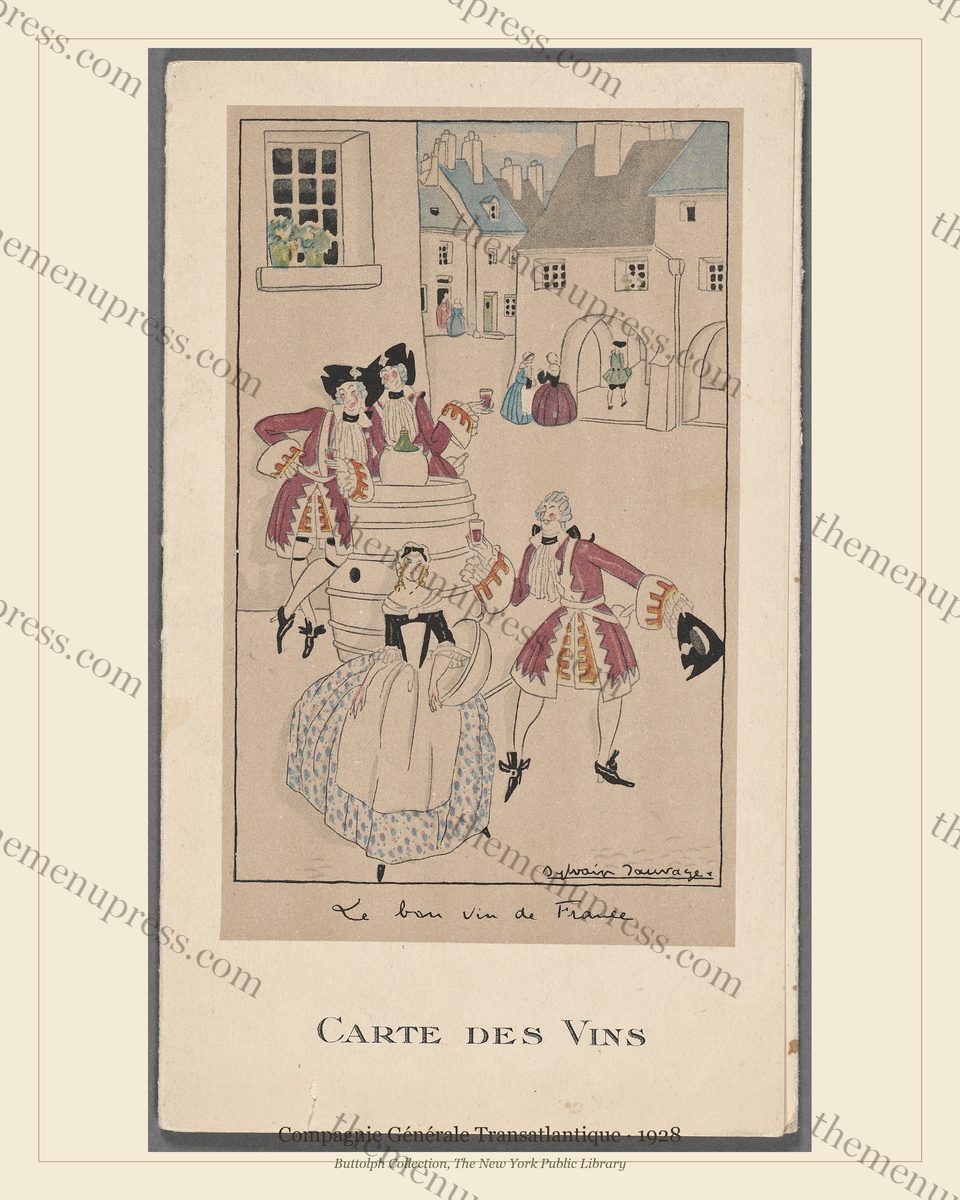
The menus themselves — the cards from which a 1900 first-class diner read the evening’s programme — survive in The New York Public Library’s Buttolph Collection. The visually strongest are catalogued in our Golden Age of Ocean Liner Menus collection.
Frequently Asked Questions
How many courses was a typical first-class dinner in 1900?
Eleven to fourteen, served over approximately two hours in fixed order, in the Escoffier French haute-cuisine tradition. Hors-d’œuvres, soup, fish, two entrées, roast, game, cold dishes, salad, dessert, savoury, fruit, coffee, cordials.
Did passengers choose from a menu?
In 1900, no. Each first-class diner received each course; the menu card listed what would be served, in order, to everyone. By 1910 limited choice (typically on the entrée and the dessert) had appeared; by 1928 modern multi-option menus were standard.
What did second- and third-class passengers eat?
Substantially less. Second class ran six to eight courses in a simpler register: soup, fish, one entrée, roast, dessert, cheese. Third class typically ran four courses, family-style or buffet, with no individual menu card (the menu was posted on a notice board). Steerage, where it still existed before 1910, received plain stews and bread.
What did first-class passengers eat on the Titanic?
The standard 1912 programme described above. The Titanic‘s final dinner card — preserved in surviving copies — lists eleven courses in the canonical Edwardian order, served in the first-class saloon on the evening of 14 April 1912. The programme was, in structure, identical to a contemporary Lusitania, Mauretania, or Olympic dinner.
Further Reading
- The Golden Age of Ocean Liner Dining 1880–1930
- The Buttolph Collection: A Curator’s Guide
- John Maxtone-Graham, The Only Way to Cross (Macmillan, 1972) — remains the definitive popular history of transatlantic dining
- Daniel Finamore & Ghislaine Wood, Ocean Liners: Glamour, Speed, and Style (V&A Publishing, 2017)