The Golden Age of Ocean Liner Dining, 1880–1930
TL;DR — For roughly fifty years between 1880 and 1930, the world’s great steamship companies turned their first-class dining saloons into floating versions of the Ritz. The menus those rooms printed — by Cunard, White Star, Norddeutscher Lloyd, Hamburg-Amerika, and the French Compagnie Générale Transatlantique — were not service documents. They were souvenirs, design objects, and quiet propaganda for the lines that printed them. This guide traces how that fifty-year arc began, how dinner and the cards that announced it evolved through three design eras, and why so many of the survivors now sit in archives instead of attics.
When the Golden Age Actually Started
The Golden Age of ocean liner dining did not begin with the Titanic. It began roughly thirty years earlier, in the early 1880s, when steel hulls made it possible to build ships large enough — and stable enough — for a first-class passenger to expect a multi-course hot meal in a saloon that did not pitch like a corridor.
The Cunard Servia, launched in 1881, is the conventional starting point. She was the first major Cunard ship built of steel rather than iron, the first lit by electricity, and her first-class dining saloon ran the full width of the ship (Maxtone-Graham, 1972, pp. 38–42). Within a decade every serious transatlantic line had followed.
By 1900 the ocean liner was no longer simply a vehicle. For seven days, in the eyes of its first-class passengers, it was a hotel. The menus changed accordingly: from the spare, almost utilitarian dinner cards of the 1870s to the multi-page, multi-language, illustrated programmes that defined the next four decades.
The end of the period is more disputed. Some historians end it in 1939 with the outbreak of war; others draw the line at the 1929 stock-market crash, after which the industry never quite recovered its pre-war confidence. We use the conventional 1930 end-point in this guide, with one or two specimens stretching to the Normandie and the final pre-war Cunarders.
The Six Lines That Mattered
Six companies produced almost all of the menus worth collecting today. They competed not just on speed and tonnage but on the look of the printed card a passenger slipped into a pocket at the end of dinner.
| Line | Country | Period of Peak Influence | House Style |
|---|---|---|---|
| Cunard Line | UK | 1840–1934 | Restrained, heraldic; embossed crests; conservative typography |
| White Star Line | UK | 1870–1934 | More illustrative than Cunard; richer paper stock; Art Deco late |
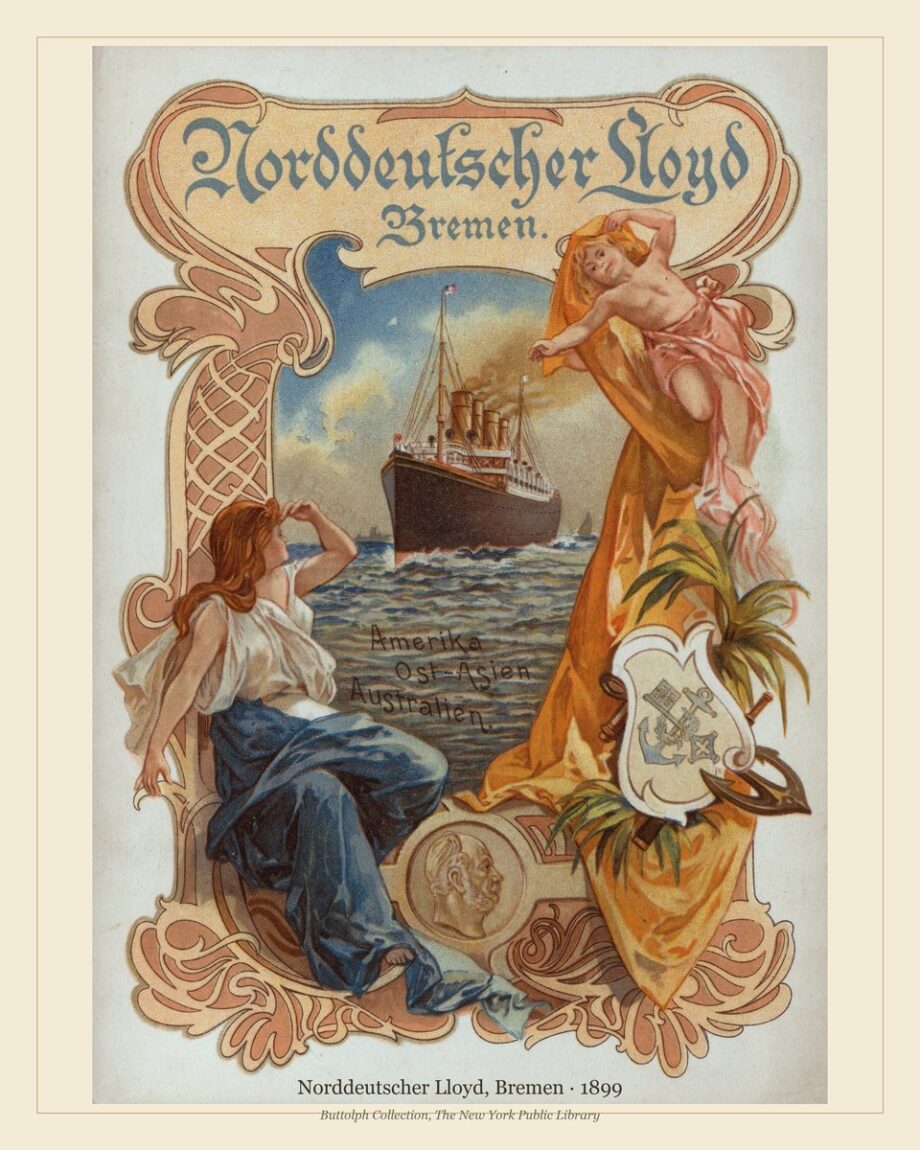
| Norddeutscher Lloyd (NDL) | Germany | 1857–1914 | Atmospheric watercolour covers; lithographed harbour scenes |
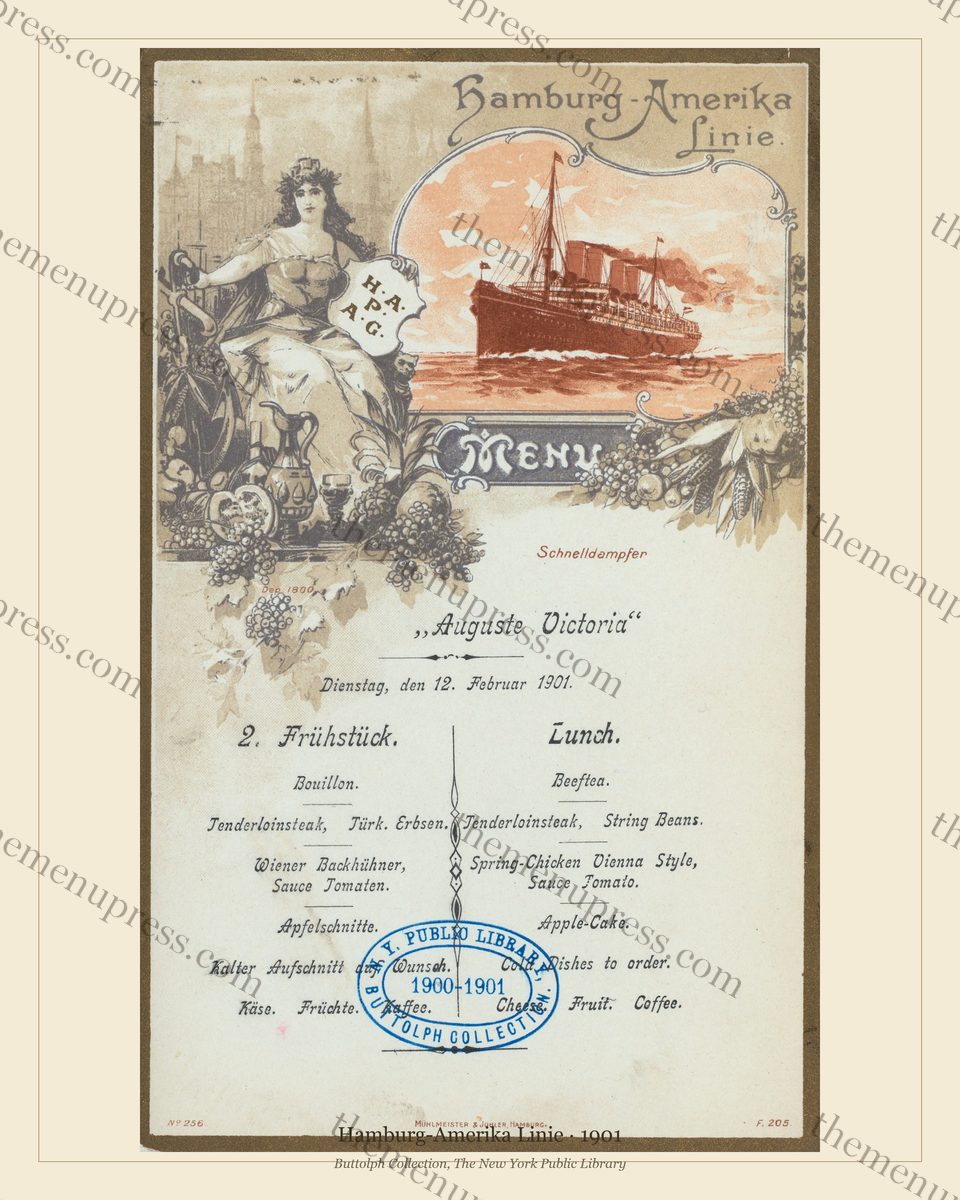
| Hamburg-Amerika (HAPAG) | Germany | 1847–1914 | Bold Art Nouveau and Jugendstil illustration; commissioned painters |
| Compagnie Générale Transatlantique (CGT / “French Line”) | France | 1864–1939 | Couture printing; high-point Art Deco menus in the 1920s |
| Royal & state vessels (RY, USN, IJN) | various | 1880–1914 | Engraved invitations; coats of arms; thick card |
A second tier — Red Star Line, the U.S. Oceanic Steamship Company, the Italian Lloyd Italiano, Japan’s Nippon Yusen Kaisha and Toyo Kisen Kaisha — produced smaller volumes of menus but in design terms they often borrowed from the lead set by these six.
What distinguished the era was the competition over the menu card itself. By 1900 the major lines were commissioning original artwork from named illustrators for each crossing. Hamburg-Amerika in particular ran a programme of watercolour covers in 1897–1906 that, if it had been on land, would now be remembered as a minor school of illustration (Finamore & Wood, 2017). We cover this in more depth in our Hamburg-Amerika Watercolour Covers 1897–1906 cluster post.
How Dinner Evolved: Three Design Eras Across Fifty Years
Across the Golden Age dinner aboard a major liner moved through three distinct cultural moments. The food and the cards announcing it moved with each.
1. The Late Victorian / Edwardian Saloon (1880–1905)
The earliest Golden-Age menus are formal, almost municipal in tone. They are printed in two languages — usually English and French — set in narrow type, and laid out as a programme rather than as an object of décor. The food is Escoffier-era French haute cuisine with British accommodations: clear soup, fish in cream sauce, a saddle of mutton, a roast game course, two cold dishes, a sweet, savouries, and dessert. Eleven to fourteen courses across two hours is normal.
What is striking to modern eyes is the absence of choice. The first-class passenger did not pick from a menu; the menu was a script for what would be served, in order, to everyone in the saloon. The card existed less to inform and more to ceremonialise.
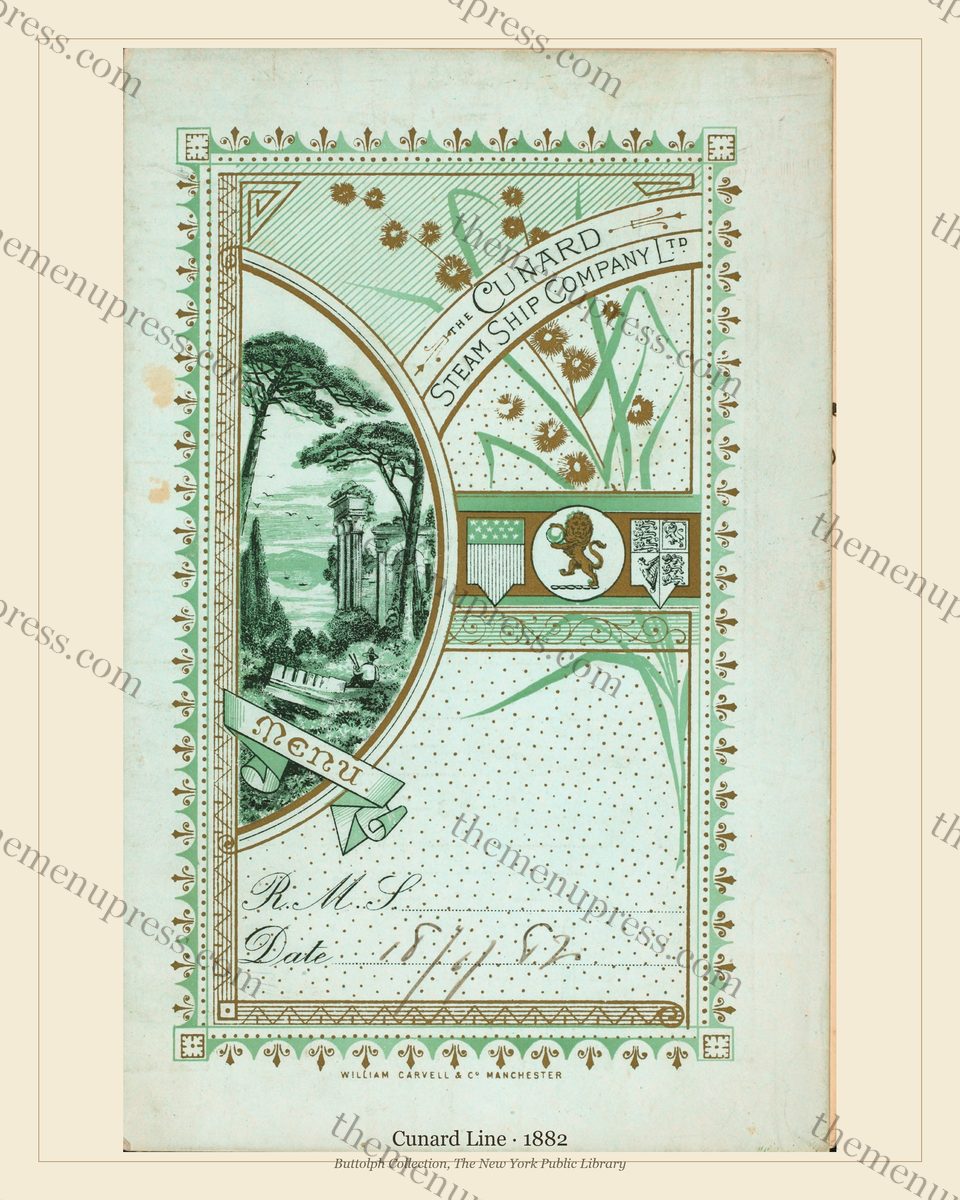
A representative survivor is our 1882 Cunard dinner card, one of the earliest pieces in the archive. The paper is laid stock, the embossing is restrained, the typography is set as if for a church programme. There is no cover illustration: the Cunard heraldic crest does all of the work.
2. The Belle Époque & Art Nouveau (1897–1914)
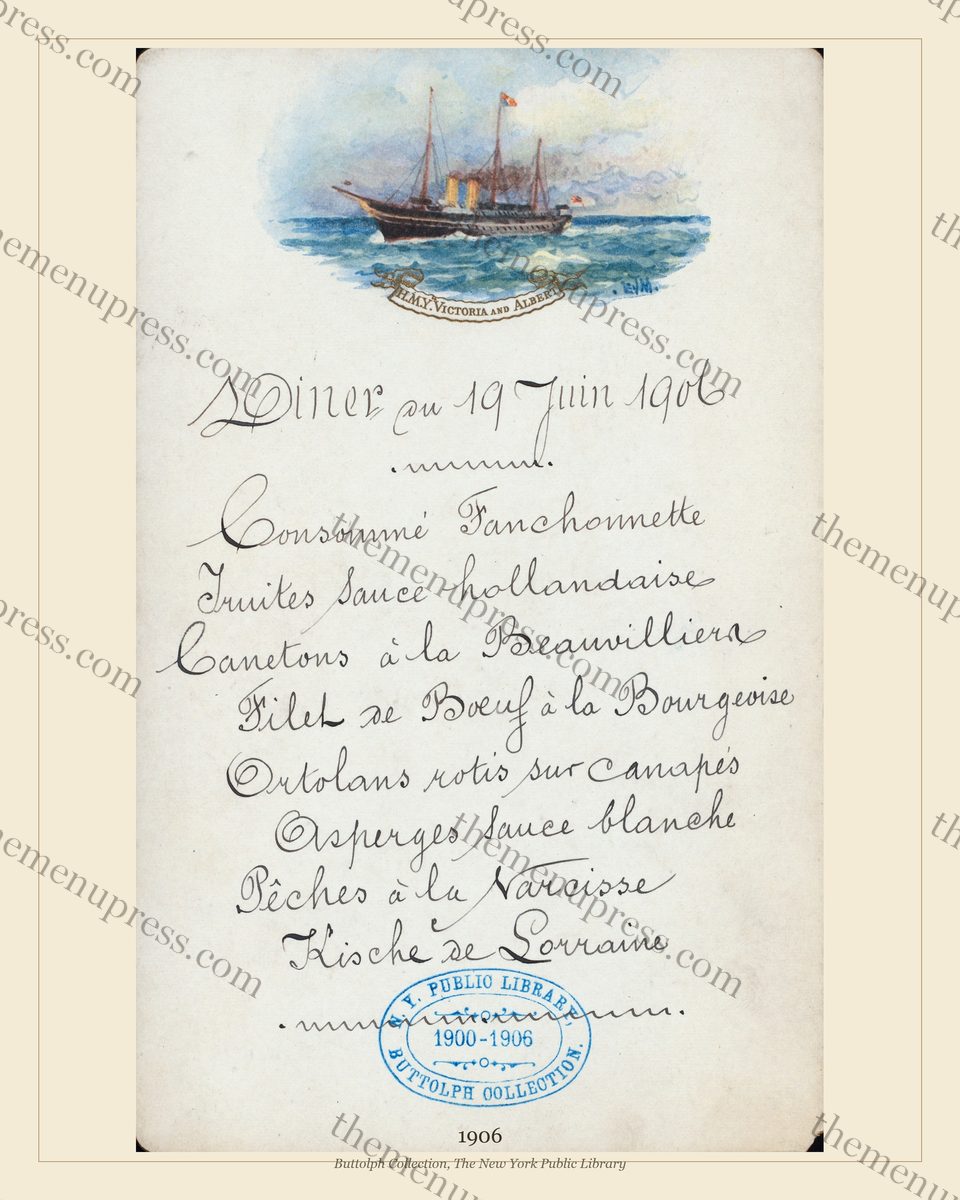
After about 1897 the German lines — first Hamburg-Amerika, then Norddeutscher Lloyd — began commissioning original watercolour and lithographic cover art for their menus. The shift was abrupt enough that it can be dated almost to the season. Within five years the British lines had been forced to respond, and by 1905 every major Atlantic carrier was issuing menus whose covers competed with the era’s poster art for visual interest.
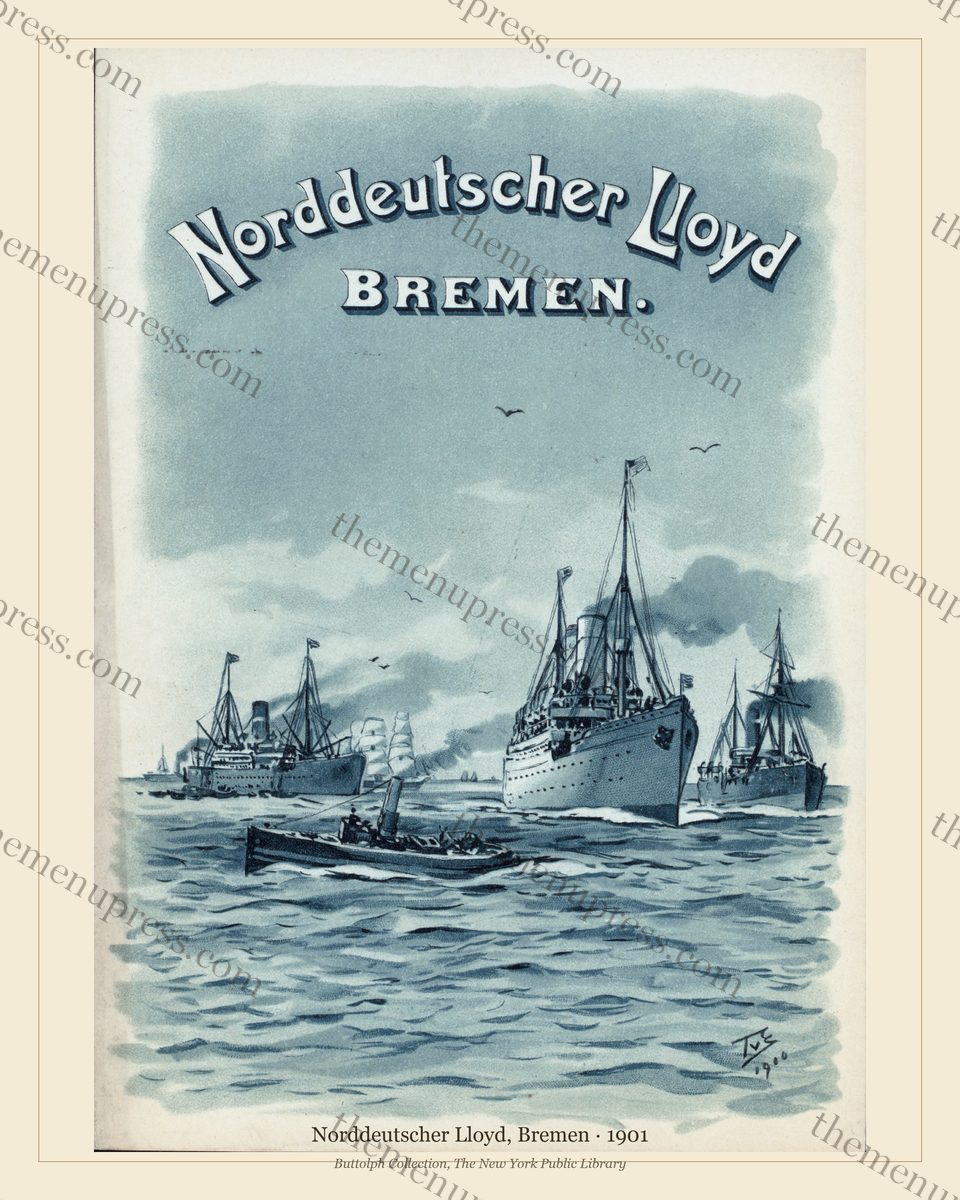
This is the era to which most of the visually strongest Golden Age of Ocean Liner Menus belong. The cover of an 1897 Hamburg-Amerika Auguste Victoria dinner menu is, by any reasonable standard, a small Art Nouveau poster in its own right. (See our deep-dive on the Auguste Victoria 1897 Menu.) The 1901 Norddeutscher Lloyd “Harbour Scene” card — a watercolour of dawn at Bremerhaven, signed by the artist on the plate — is closer to a souvenir lithograph than to a piece of restaurant ephemera.
The food shifts subtly too. Choice begins to appear on the card — usually limited to the entrée, but visible. Wine lists become a separate, multi-page document. Coffee and the after-dinner cordial programme migrate to their own card. The menu, in other words, is splitting into a suite of paper objects, each with its own design responsibility.
3. The Inter-war Art Deco (1919–1930)
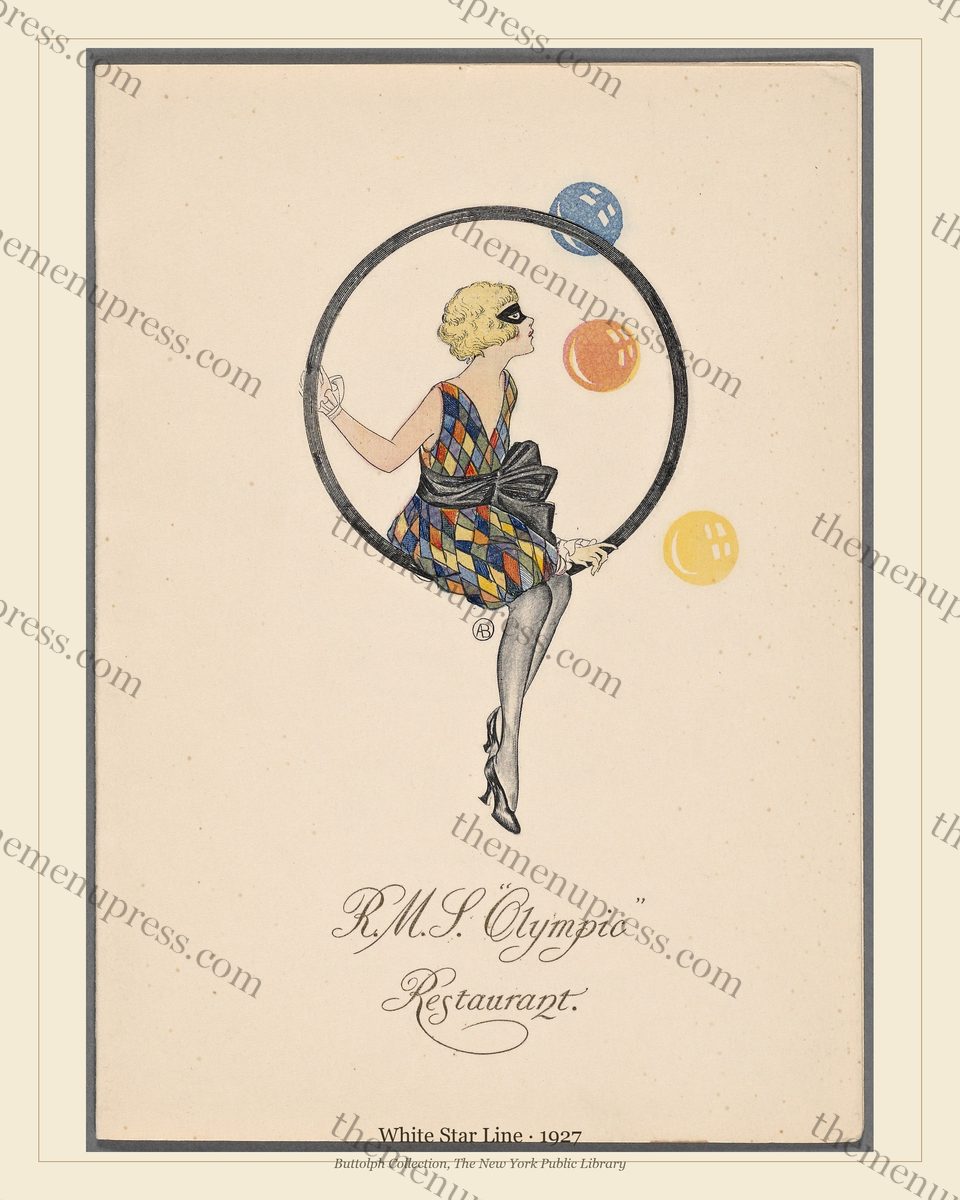
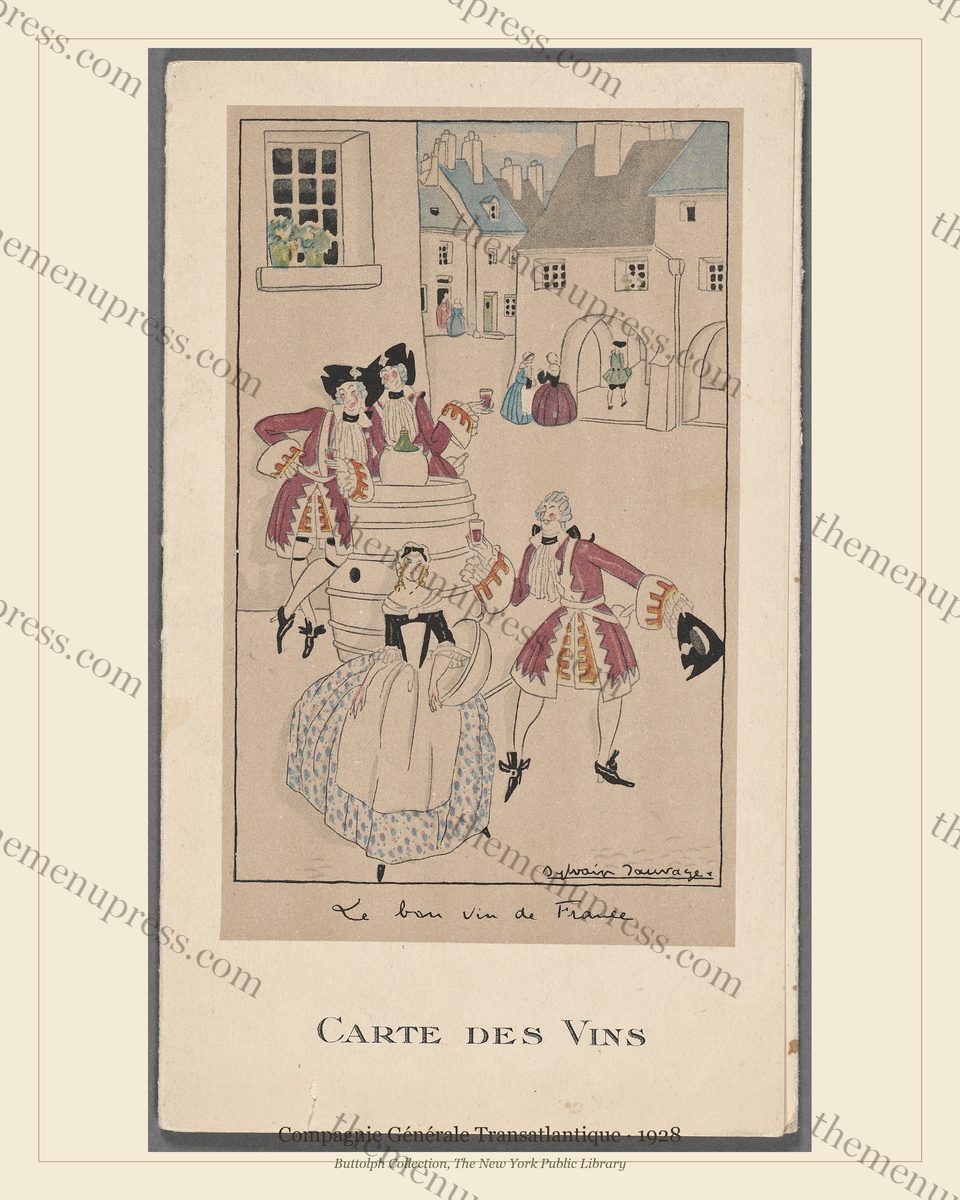
After the First World War the visual register changes again, and quickly. The watercolour covers of 1900 give way to geometric, high-contrast Art Deco compositions. The 1928 Carte des Vins from the Compagnie Générale Transatlantique is the canonical example: a wine list whose cover, by any contemporary art-historical measure, is a peer to the great French Art Deco poster work of the same decade. (We unpack this card at length in The 1928 CGT Carte des Vins.)
White Star’s Olympic, refitted in the mid-1920s and operating until 1935, issued menus in this register through the end of her service. The 1927 Olympic dinner card preserved in the archive — see our RMS Olympic 1927 deep-dive — is essentially an Art Deco object that happens to also be a list of what passengers were eating in the second-class saloon.
The food on board has now genuinely modernised. The eleven-course Edwardian dinner has retreated to eight, then six. Cocktails appear on a separate menu. The savoury course quietly dies. The cuisine is still recognisably French in idiom but it has acquired American accommodations — a salad course on the same plate as the entrée, ice cream desserts, named cocktails before dinner.
If you’re already designing around one of these eras — the cards in our archive from the late Victorian, Belle Époque, and Art Deco periods are catalogued by company and date so you can build a wall around a single decade or a single line. The most-requested starting points are the Olympic 1927, the CGT Carte des Vins 1928, and the Hamburg-Amerika 1897–1906 watercolour group.
The Menu Card as Object: Paper, Format, Illustration
The reason these menus are worth printing on a wall today, and not merely worth reading, is that they were designed to be kept. The lines knew their passengers slipped the dinner card into a coat pocket as a souvenir of the crossing. Card stock, format, and printing reflected that expectation.
A few technical conventions held across the period:
- Format. The standard first-class dinner menu was a folded card, roughly 6½ × 9 inches when closed, opening to a single sheet of 9 × 13 inches. The cover carried the illustration; the inside-spread carried the menu in two languages; the back was either blank or carried a small house notice.
- Paper. Uncoated laid or wove stock, white to ivory, between 250 and 350 gsm. The German lines used noticeably heavier card than the British. By the 1920s the French were experimenting with coated stocks for the cover only, leaving the menu pages uncoated for legibility.
- Printing. Letterpress for the menu text well into the 1910s. Lithography for the cover illustrations from roughly 1895 onwards. Chromolithography (multi-stone colour) for the most elaborate covers — Hamburg-Amerika in 1897–1906 is the canonical case.
- Embellishment. Embossing, gilt edging, blind-stamped crests, ribbons threaded through stab-bound spines. By 1900 a Hamburg-Amerika dinner menu in the first-class saloon could carry production values closer to a wedding invitation than to a printed restaurant ephemera.
What this means for a modern viewer is that an 1897 menu cover holds up at large print sizes — 11×14 or 16×20 inches — in a way that a contemporary digital file would not. The original artwork was conceived for, and printed on, a substrate that flatters scaling. This is why the surviving cards make defensible wall art today, and why the editorial decision to reprint them on archival matte paper is not a stretch but a continuation.
Class and Cuisine: Who Ate What
The Golden-Age liner ran a three-class system (later four, with the introduction of “tourist” cabin in the 1920s), and each class ate from a different menu — printed differently, on different paper, with different food, in a different room.
| Class | Room | Card | Typical Dinner |
|---|---|---|---|
| First class | The Saloon (full-width, central, top-deck) | Illustrated cover card, 8–14 courses, French-influenced | Consommé, fish, two entrées, roast, salad, dessert, savoury, fruit |
| Second class | A smaller dining room, often one deck below | Simpler card, single colour, 6–8 courses | Soup, fish, one entrée, roast, dessert, cheese |
| Third class | Open seating, communal tables | Often no individual card; menu posted on a notice board | Plain meat, vegetable, bread, beer or coffee |
| Steerage (pre-1900) | Below deck, no service | No printed menu; ship’s company provided rations | Stew, bread, water |
The hierarchy was the point. A first-class passenger paying £25 to £40 in 1902 for an Atlantic crossing was paying as much for the experience of being served from an illustrated menu in a panelled saloon as for the transport itself (Maxtone-Graham, 1972). The card was a small, persistent reminder of that fact.
For a modern restaurant or bar operator drawing on the period for design cues, this matters: an authentic 1900s menu carries class signals that contemporary “vintage-look” reproductions often miss. A real Hamburg-Amerika 1900 card was first-class material. Most printable “vintage menu” images now sold online are loose pastiches that quietly drop those class signals. The originals do not.
The Long End: 1930–1939
The Golden Age did not so much end as run out of money. The 1929 crash collapsed first-class transatlantic traffic almost overnight. The new American immigration quotas of 1924 had already destroyed the third-class market on which the lines had cross-subsidised their first-class loss-leaders. By 1934 Cunard and White Star — for thirty years the two great rivals — had merged into Cunard-White Star Limited.
What survived into the 1930s, and is often the work most familiar to a modern audience, is a kind of late Art Deco — Normandie (1935), Queen Mary (1936), Queen Elizabeth (1940) — that was visually magnificent but commercially a long retreat. The menus from this period are accomplished but few in number. Most of the work that defines the Golden Age in retrospect was already done by 1928.
The Second World War absorbed the surviving fleet into troop service. The post-war jet age, when it arrived in 1958 with the Boeing 707 transatlantic schedule, ended the ocean liner as a commercial proposition. The menu card, as a printed object commissioned with original cover art for each crossing, did not survive the transition.
How to See These Menus Today
Most Golden-Age menus are now held in institutional archives. The single largest is the Buttolph Collection of Menus at The New York Public Library — roughly 25,000 cards collected between 1900 and 1924 by a New York librarian named Frank E. Buttolph, who simply wrote to every restaurant, ship, hotel, and club she could identify and asked them to send her one of each printed menu. Most of the major lines complied. The collection is now in the public domain in the United States.
Other significant holdings:
- The Mariners’ Museum, Newport News, Virginia — ocean-liner ephemera with a strong focus on White Star and Cunard
- The V&A, London — held the major Ocean Liners: Speed and Style exhibition in 2018, which surfaced many private and corporate holdings
- Peabody Essex Museum, Salem — strong on the North Atlantic German lines
- Musée National de la Marine, Paris — the definitive CGT / French Line holdings
- Deutsches Schiffahrtsmuseum, Bremerhaven — NDL and Hamburg-Amerika archival material
Of these, the Buttolph Collection is the most useful starting point for anyone interested in the printed menu specifically, because Buttolph collected with completism rather than with curatorial bias. Her archive captures the period’s full range — the great first-class dinner cards alongside the small, almost throwaway second-class menus that almost no other archive bothered to preserve.
The work of The Menu Press is to curate from that source: to identify the cards in the Buttolph holdings that are visually strongest, datable, and printable at modern decorative sizes, and to restore and reformat them — minimally, in the conservation tradition — for use as wall art. Each card in our Golden Age of Ocean Liner Menus collection is a single Buttolph holding made print-ready.
Putting One on Your Wall
The cards from this period that are visually strongest tend to fall into three buyer patterns. Each is a defensible design choice, and each will read differently on a wall.
- A single Art Deco statement piece. Usually the Olympic 1927 dinner card or the CGT Carte des Vins 1928. Hung alone at 16×20 inches it carries a wall on its own. Best for cocktail bars and dining rooms with a deliberately modernist hand.
- A three- or four-piece Hamburg-Amerika watercolour grouping. The 1897–1906 Art Nouveau covers read as a coherent set. Best for spaces with a Belle Époque or Edwardian register, and for hospitality interiors that want a soft, painterly palette rather than a hard geometric one.
- A chronological sweep. One card per decade across the four eras — 1882 Cunard, 1897 Hamburg-Amerika Auguste Victoria, 1901 NDL Harbour Scene, 1927 White Star Olympic, 1928 CGT Carte des Vins. Best for hotel lobbies, restaurant entrances, or any space that benefits from a curated linear story.
→ Browse the Golden Age of Ocean Liner Menus collection
Frequently Asked Questions
What years are usually meant by “the Golden Age of ocean liner dining”?
The conventional dates are 1880 to 1930, with the Cunard Servia of 1881 as the start point and the 1929 stock-market crash as the end point. A handful of late ships — Normandie (1935), Queen Mary (1936) — produced work in the same idiom into the late 1930s, but the era’s commercial peak was 1900–1928.
Are “vintage cruise ship menus” and “ocean liner menus” the same thing?
In casual usage often, but technically they are different ship types from different eras. Ocean liners are the long-distance scheduled-service passenger ships of roughly 1880–1960 that carried people and mail between continents — Cunard, White Star, Hamburg-Amerika, Compagnie Générale Transatlantique. Cruise ships are the leisure-oriented vessels of the post-1960s that run round-trip recreational itineraries. The “vintage menu” most people picture when they search for “cruise ship menus” is almost always in fact a Golden-Age ocean liner menu — the cards from 1900-era Cunard, White Star, NDL, or Hamburg-Amerika that this article covers.
Which line produced the most visually significant menus?
Critically, the German lines — Hamburg-Amerika (1897–1906 watercolour covers) and Norddeutscher Lloyd (1900–1910 lithographic covers). Commercially, the French — Compagnie Générale Transatlantique in its Art Deco period (1924–1932). The British lines, Cunard and White Star, were more conservative in cover art but matched the others in production quality.
What did first-class passengers actually eat on a 1900 transatlantic crossing?
An eleven- to fourteen-course dinner in the Escoffier French haute-cuisine tradition: consommé, fish course in a cream sauce, two entrées, a roast meat course, game in season, cold dishes, salad, dessert, a savoury, fruit, coffee, and an after-dinner cordial. Service ran approximately two hours. We cover this in detail in our What First-Class Passengers Ate on a 1900s Transatlantic Crossing post.
Are these menus in the public domain?
The original menu artworks held in the Buttolph Collection at The New York Public Library are in the U.S. public domain. The Library has released them for unrestricted use. Curatorial selection, restoration, and editorial work performed on those scans by third parties — including The Menu Press — are independently copyrighted.
Where can I see or buy a printable version?
Most major holdings are viewable online through their host institutions. For curated, restored, and print-ready files sized for home or commercial framing, see our archive, which draws specifically from the Buttolph holdings.
Further Reading
Cluster posts in this pillar (continuing weekly):
- A History of Cunard Line Menus 1840–1934 (scheduled W3 Fri)
- What First-Class Passengers Ate on a 1900s Transatlantic Crossing (scheduled W4 Fri)
- Norddeutscher Lloyd: The Forgotten German Atlantic Giant (scheduled W5 Tue)
- Hamburg-Amerika Watercolour Menu Covers 1897–1906 (scheduled W6 Tue)
- The 1928 CGT Carte des Vins: Art Deco’s High Point at Sea (scheduled W3 Tue)
- RMS Olympic 1927: The Last Year of an Art Deco Liner (scheduled W4 Tue)
External references and further reading:
- John Maxtone-Graham, The Only Way to Cross (Macmillan, 1972) — the definitive popular history of the North Atlantic transatlantic trade
- Daniel Finamore & Ghislaine Wood, Ocean Liners: Glamour, Speed, and Style (V&A Publishing, 2017) — exhibition catalogue, V&A 2018
- Frank E. Buttolph and the Buttolph Collection of Menus — Wikipedia biographical entry
- Ocean liner — Wikipedia overview of the vessel type and its history