Custom Framing for Vintage Menu Prints: When It’s Worth $200 (And When It Isn’t)
TL;DR — Custom framing is the right answer for one menu out of ten. The other nine are better served by a thrift-store vintage frame + new glass ($35 total), or an off-the-shelf IKEA Ribba with a generous mat ($25). The framing decision should follow the role the menu plays in the room: signature piece → custom; gallery wall member → off-the-shelf or thrift; quick decor → off-the-shelf. This piece walks the honest case for and against custom framing, what to specify when you do go custom (Michaels 50% off coupon vs. independent frame shop), and the three upgrades that are actually worth the money.
The honest case for custom framing
A custom-framed vintage menu is the best version of the piece. There is no debate about this.
A trained framer sees things you don’t see. Mat proportions calibrated to the print’s internal margins. Frame profiles that echo the menu’s own typography. UV-protective glass that prevents the print from fading over a decade. Float mounting that lets the original paper edges read as edges, not as something hidden behind a mat. Acid-free everything, sealed properly, so the piece looks the same in 2046 as it does the day it’s hung.
For one menu — the menu the room is built around — this is real value. The piece becomes architectural. Guests notice it the way they’d notice a piece of furniture or a light fixture: it’s part of how the space works.
The price for this is $80–$300 depending on size and choices. For a 16×20 piece behind the bar at a serious cocktail venue, $200 is reasonable. For a $30 IKEA Ribba behind a $25 Mpix print on the same wall, the difference is visible from across the room.
The honest case against custom framing — for most pieces
Custom framing scales badly.
If the room calls for one statement piece, $200 is reasonable. If the room calls for six menus on a gallery wall, $200 × 6 = $1,200, and now the math is wrong. The same $1,200 spent on six thrift-store vintage frames ($90 total) plus six Mpix matte prints ($150 total) plus six pieces of new glass cut by a frame shop ($120 total) gets you the same gallery wall — with frames that have actual historical patina — for $360, with $840 left over.
The wall is not better with $1,200 of custom framing than with $360 of thrift-and-print. It’s just more expensive.
This is the core trade. Custom framing buys quality per piece. Volume kills custom framing.
The role test
Before deciding whether to custom-frame a menu, ask one question: what is this menu’s role in the room?
There are three roles:
- Signature piece. The one thing the wall is built around. Guests stand in front of it. Custom framing is correct.
- Gallery member. One of 4–10 in a curated wall. Frame consistency matters more than per-frame quality. Off-the-shelf or thrift.
- Quick decor. Filling a wall pocket, dressing a hallway, decorating a home office. Off-the-shelf IKEA is correct.
If you’re framing more than two signature pieces in the same room, one of them isn’t a signature piece. The eye can only register one anchor per visual field.
Where to get custom framing done
Two options.
Michaels Custom Framing (with the 50% off coupon)
The volume play. Michaels does competent custom framing — acid-free mats, real moldings, proper mounting, real glass options. The catch is the pricing structure: full price is dramatically overpriced, but they email 50% off coupons constantly.
Never pay full price at Michaels. If you signed up for their email list, a 50% off custom framing coupon arrives every 2–4 weeks. With the coupon, expect:
- 11×14 with mat and regular glass: $50–$90
- 16×20 with mat and regular glass: $90–$150
- 16×20 with mat and UV glass: $110–$180
Quality is solid mid-tier. Frame selection is broad but commodity. Turnaround is 2–3 weeks. Good for any piece that isn’t the signature piece.
Independent local frame shop
The craft play. Independent framers — usually a single owner or small team in a brick-and-mortar shop — do dramatically better work than chain stores. Better frame selection (often including genuinely vintage moldings or hand-finished options), more careful mounting, more thoughtful mat proportions, and someone who actually looks at your piece and thinks about it for ten minutes before quoting.
Expect:
- 11×14 with mat and regular glass: $80–$160
- 16×20 with mat and UV glass: $140–$280
- 20×30 with float mount and museum glass: $220–$400+
Worth it for one or two centerpiece pieces. Not worth it as a default for everything.
How to find a good one: Google “custom picture framing [your city].” Read reviews. Visit before you bring a piece in — the shop’s own framed display work tells you everything you need to know about their taste. A shop with elegant displays will do elegant work for you; a shop with cluttered displays won’t.
The three upgrades that are actually worth the money
Custom framing is a menu of upgrades. Most of them are not worth paying for. Three are.
1. Acid-free mat — $0 upcharge
Every custom framer offers this. Most don’t volunteer it. Always ask for an acid-free (sometimes called “conservation” or “rag”) mat. It costs the same as a standard mat at most shops, and standard mats yellow over 10–20 years, slowly staining the print edges. There is no reason to ever buy a non-acid-free mat for a piece you want to keep.
2. UV-protective glass — $20–$40 upcharge
Sunlight fades pigment ink prints. Even pigment-based archival prints fade noticeably after 5–8 years of indirect sunlight; faster with direct exposure. UV glass blocks 97–99% of UV transmission and dramatically extends the visible-color life of the print.
Worth it when: Any piece hung where natural light hits, even briefly. Worth the $25–$40 even on a $90 Michaels job.
Not worth it when: Interior wall in a windowless room. Above a bar back where bottles block all natural light. Anywhere artificial light only.
3. Float mounting — $30–$60 upcharge
The print sits on a small shadow gap with no mat, the original paper edges visible. The frame becomes a window onto the menu rather than a border around it.
Worth it when: The menu has interesting edges. Original deckle edges, intact margins with printed flourishes, hand-cut corners. Float mounting honors those edges instead of hiding them behind a mat.
Not worth it when: The menu’s edges are clean rectangles with no visual interest. Standard matting reads better.
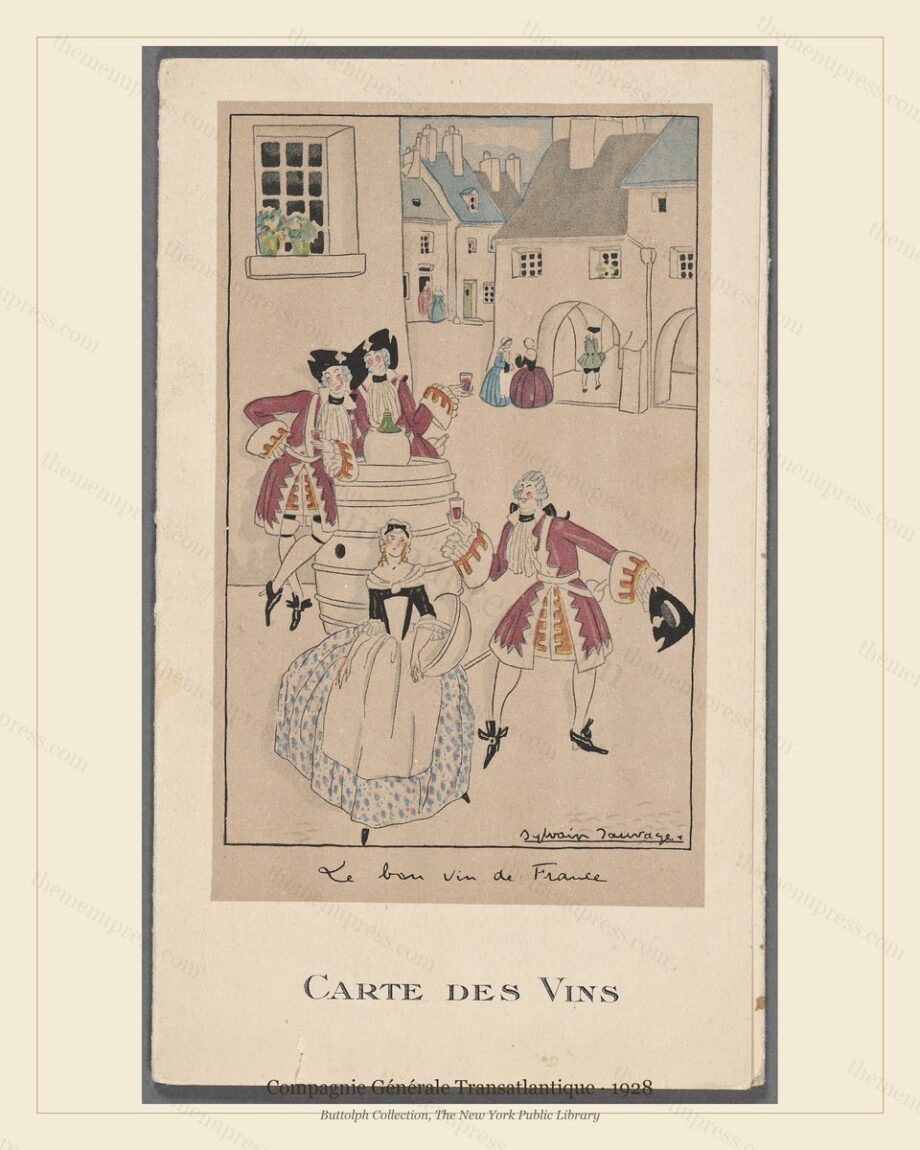
For vintage menus from the Buttolph Collection, most pieces look better float-mounted than matted — but only at the signature-piece tier, where the per-frame cost already justifies the upgrade.
A practical decision tree
Working through one menu, top to bottom:
1. Is this the signature piece in the room? If yes → custom framing at an independent shop. UV glass. Float mount if edges are interesting. Budget $150–$300. Stop. 2. Is this one of 4–10 menus on a gallery wall? If yes → thrift-store vintage frame + new glass + Mpix matte print. $35–$60 per piece. Skip custom framing. Stop. (Full thrift-frame sourcing guide: see our vintage frames piece.) 3. Is this filling a wall pocket or dressing a casual space? If yes → IKEA Ribba in matte black or white. $15–$30 per piece. Stop. 4. Are you unsure? Then it’s almost certainly category 2 or 3. Custom framing is for pieces you’re certain about.
A closing note on regret
The most common framing regret is over-investing in pieces that turn out to be category 2 or 3. Spending $200 on custom framing for a menu that ends up on a gallery wall is money wasted — not because the framing is bad, but because the role didn’t justify the spend.
The opposite regret — IKEA-framing a signature piece — is rarer and easier to fix. Replacing an off-the-shelf frame with a custom frame later is straightforward. The print is the same; only the frame changes.
When in doubt, default to under-spending. You can always upgrade a frame later. You can’t easily un-spend $200.
The role-based framework above applies to the full framing-and-printing decision. Our print and frame guide maps each role to a print path (Walgreens vs Mpix vs giclée) alongside the frame path — use both together.
The Menu Press curates and republishes vintage menus from the public-domain Buttolph Collection at the New York Public Library. Each file ships in six print-ready sizes at 300 DPI, ready for any framing path above.