The Buttolph Collection: A Curator’s Guide
TL;DR — The Buttolph Collection of Menus is the largest single archive of historic printed menus in the world: approximately 25,000 cards collected between 1899 and 1924 by a New York Public Library cataloguer named Frank E. Buttolph. The collection now sits in the public domain and is the source archive for virtually every serious modern reproduction of late-Victorian, Edwardian, Belle Époque, and Art Deco menu material. This guide explains who Buttolph was, how she built the archive, what is and is not in it, and how to read its strongest material.
Who Was Frank E. Buttolph?
Frank E. Buttolph (born 1850, died 1924) was a New York librarian and cataloguer who, beginning in 1899, undertook one of the most quietly consequential acts of single-handed archival collecting in American library history. Her first name was Frances; she signed her correspondence “F. E. Buttolph” and was addressed as “Mr.” in many of the printed sources she received in reply — a routine misreading she did not correct, since it made her requests more likely to be answered.
She had no academic credentials in the modern sense, no institutional mandate, and at the time she began her project, no salary for it. She proposed the collection to the New York Public Library in 1899, persuaded the Library to host and store what she collected, and then spent the next twenty-five years writing letters — thousands of letters — to restaurants, hotels, ocean liners, dining clubs, railroad dining companies, ladies’ societies, and steamship lines on every continent, asking each to send her a copy of every printed menu they used.
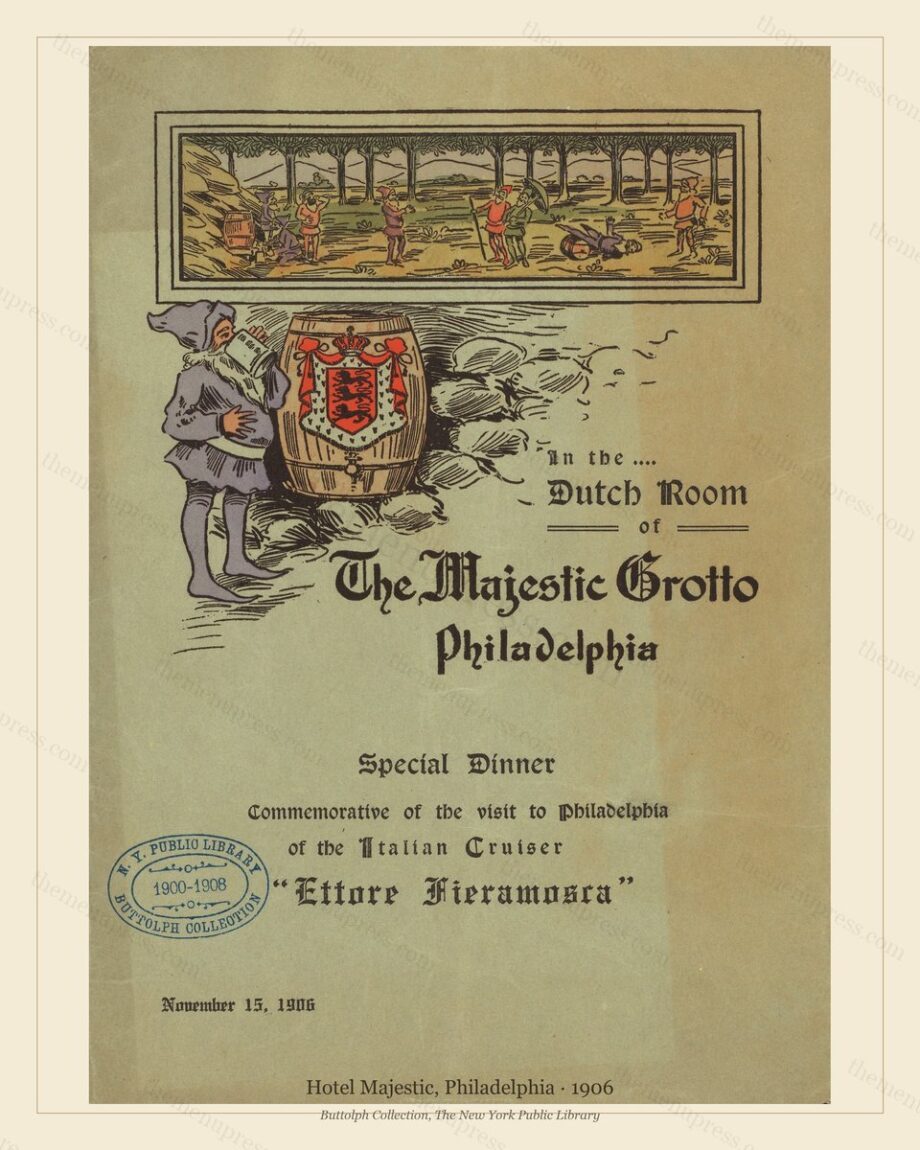
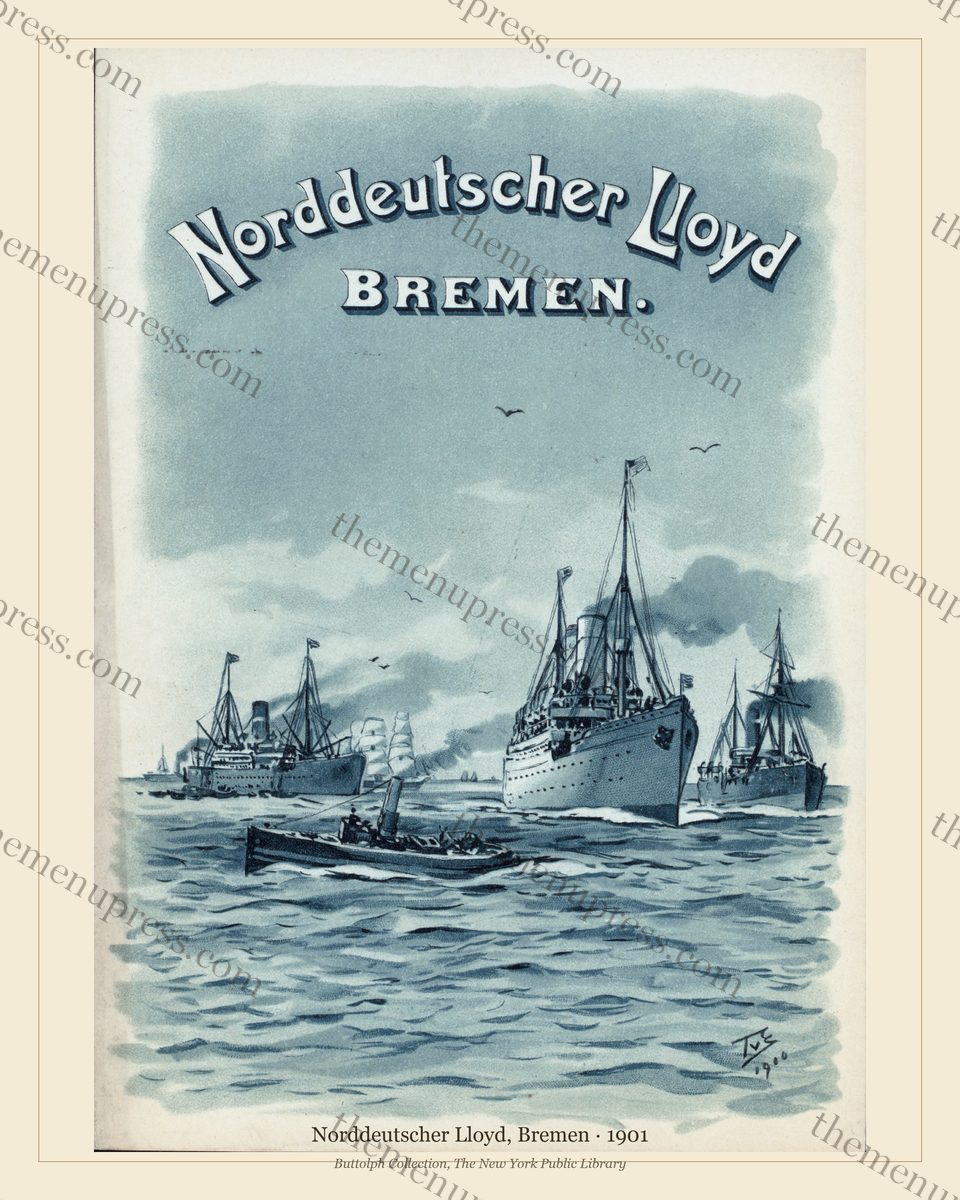
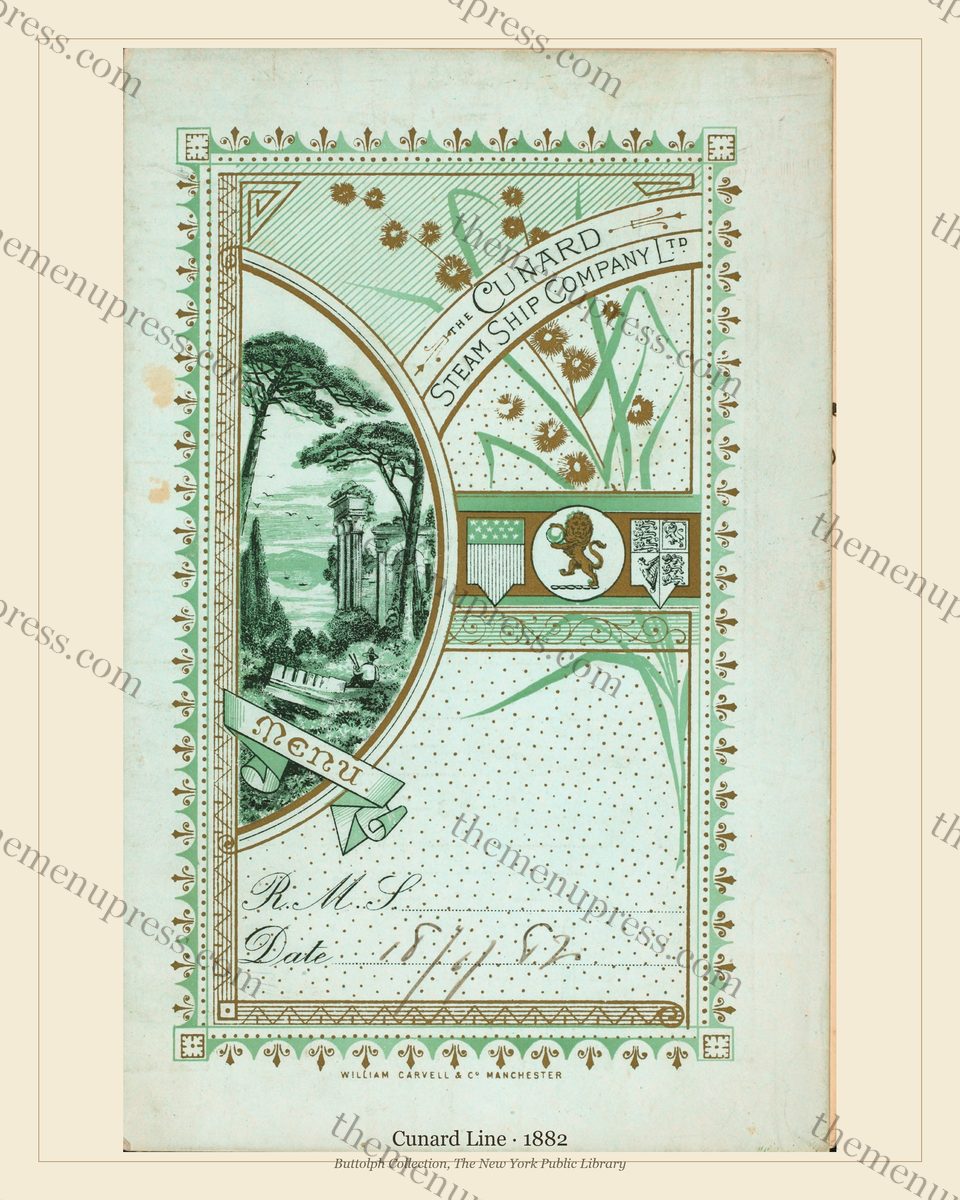
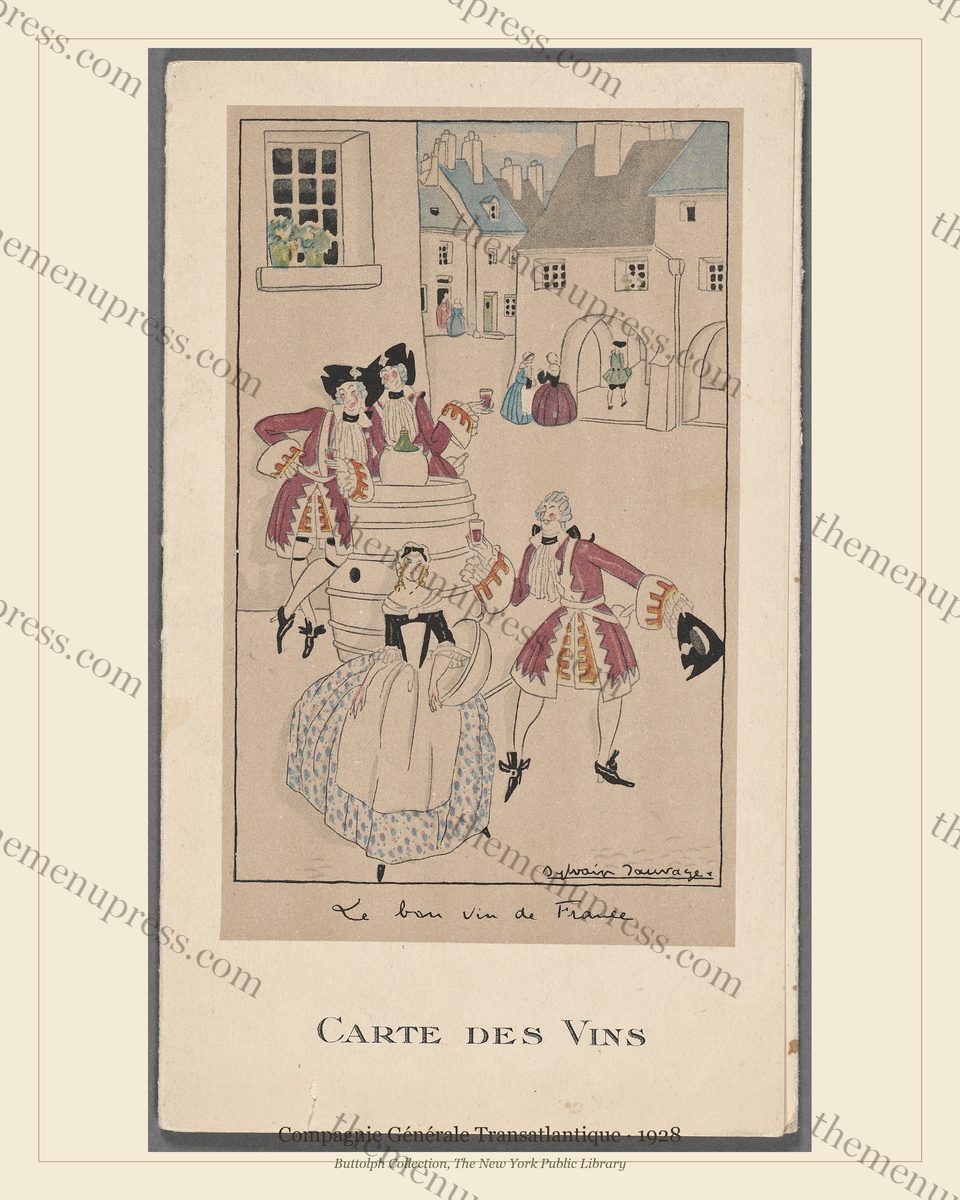
The cooperation rate was extraordinarily high. The major Atlantic lines — Cunard, White Star, Norddeutscher Lloyd, Hamburg-Amerika, Compagnie Générale Transatlantique — sent regular shipments. So did the great New York hotels (the Waldorf-Astoria, the Plaza), the Pullman dining cars, the New England summer-resort hotels, and a remarkable long tail of one-off banquets at fraternal lodges, college reunions, and society weddings whose menus would otherwise have survived in nothing more durable than a guest’s coat pocket.
By her death in 1924 she had built an archive of approximately 25,000 menus — an order of magnitude larger than any comparable institutional collection. The Library catalogued and preserved the material under her name (Maxtone-Graham, 1972). It has been freely consulted by food historians, design researchers, and decorative-arts curators ever since.
How the Collection Was Built
Buttolph’s method was almost comically simple and almost impossible to replicate today. She wrote letters. The letters were polite, brief, and made clear that her request was institutional rather than personal: she was building a reference collection at the New York Public Library and would the recipient be willing to send their printed menus — current and back-issues — for inclusion?
The reason this worked is that printed menus in 1900 were promotional material. A restaurant or shipping line had no reason to deny them, every reason to send them. Many recipients sent not just one menu but standing subscriptions: every new menu, as it was printed, mailed to Buttolph in a brown envelope. The Cunard Line was a particularly cooperative correspondent through the late 1900s and 1910s; the German lines, less correspondent-prone in general, nevertheless sent material via their New York booking offices. The result is an archive whose strength is structural, not anecdotal: it preserves routine menus, not just exceptional ones.
This matters because almost no other archive captures the routine. Most surviving menus in private collections are exceptional — first crossings, captain’s dinners, royal visits, signed by celebrities, snipped from notable wedding programmes. The Buttolph holdings include those, but they also include a Tuesday lunch on a German immigrant ship in 1903, a third-class breakfast card from a White Star Line crossing in 1907, a wedding-reception menu for a couple no one outside their immediate family ever heard of. The collection’s value to historians is precisely that it preserves the ordinary — the documentary evidence of how dining culture actually worked, not how its most photogenic moments are remembered.
What Is Inside the Collection
The roughly 25,000 holdings span 1851 to 1930 with the densest period 1895 to 1920. Six broad categories account for most of the material.
| Category | Approximate share | Representative examples |
|---|---|---|
| Ocean-liner / steamship | ~30% | Cunard, White Star, NDL, Hamburg-Amerika, CGT, Red Star, Holland-America |
| Hotel banquets & restaurants | ~25% | Waldorf-Astoria, the Plaza, Delmonico’s, the Hotel Majestic, Sherry’s |
| Railroad & dining-car | ~10% | Pullman, NYC, Pennsylvania Railroad, Santa Fe, the Twentieth Century Limited |
| Society / private events | ~15% | Wedding receptions, fraternal-order banquets, alumni reunions, civic dinners |
| Royal / state / naval | ~5% | Royal Yacht Victoria and Albert, U.S. naval receptions, state dinners |
| Cafes, clubs, miscellaneous | ~15% | Gentlemen’s clubs, women’s clubs, tea rooms, summer-resort dining rooms |
What is striking, surveying the holdings as a whole, is the geographic distribution. American sources dominate, as one would expect from a New York-based collector. But the European share is large — British, German, and French menus together account for perhaps a third of the total — and there is meaningful Japanese, Italian, and South American material. The reason is the shipping lines: by 1905 every major transoceanic carrier had a New York booking office, and Buttolph cultivated those offices systematically.
What the Buttolph Archive Captures That Other Archives Miss
Three things, specifically. Each of them is the reason food historians and dining-design researchers return to this archive rather than to the larger but thematically narrower collections at the Library of Congress, the V&A, or the Mariners’ Museum.
1. The middle of the menu, not just the cover
Most surviving menus in private collections are valued for their cover art. The interior — the actual food, in two columns, in two languages — is often lost or torn. Buttolph filed her holdings intact. The result is that the collection is one of the few sources from which a researcher can reconstruct what was actually served on, for example, a Cunard Lusitania crossing in 1907 — not just admire the cover the kitchen department printed.
2. The cards that were never meant to be kept
Most surviving banquet menus are the elaborate keepsake cards: thick stock, gilt edges, ribbon-tied, distributed to honoured guests. The Buttolph holdings include those, but they also include the rougher cards distributed to ordinary attendees and the working dining-room copies passed back and forth at the table. These “ephemeral” survivors are now perhaps the most distinctive part of the archive, because they exist almost nowhere else.
3. The breadth across class
The collection’s most quietly important feature is that it preserves third-class steamship menus, working-railroad dining-car cards, and modest-restaurant printed bills of fare alongside the first-class material. This is rare. Most archives, by virtue of what donors and collectors chose to preserve, are heavily skewed toward the most elaborate end of the printed-menu spectrum. Buttolph’s letters did not discriminate; her archive does not either.
Why the Buttolph Collection Survived When So Many Others Did Not
Most institutional menu collections from the 1900–1930 period did not survive. The Smithsonian has fragments; the Library of Congress has fragments; most New England hotel and steamship company archives were destroyed in mergers, fires, and the corporate consolidations of the 1930s and 1940s. What allowed the Buttolph archive to survive intact was institutional: she had placed it inside the New York Public Library from the beginning, with the Library’s cataloguing apparatus around it. When she died, the material did not need to find a new home, navigate an executor, or compete for storage budget — it was already where it lived.
A second factor was that the Library understood the archive’s reference value early. By 1925 the New York Public Library was already lending the Buttolph material to food historians, hotel-industry researchers, and the early generation of decorative-arts scholars. The collection was used, which meant it was protected; it was not put into a basement and forgotten.
In 2010 the Library digitised the entire collection at high resolution and released the originals into the public domain in the United States, where they remain. The digital images are searchable; the underlying physical material is housed in the Library’s Stephen A. Schwarzman Building on Fifth Avenue.
How to Read the Buttolph Collection: A Short Curator’s Method
The archive is large enough that a researcher who simply opens it at random will be overwhelmed. Three reading methods make the volume tractable.
- Read by line or institution. Take a single shipping line, hotel, or club and read its complete Buttolph holdings in chronological order. The story of, for example, the Cunard menu programme from 1880 to 1930 reads as a coherent thirty-year design narrative when assembled from this archive. Reading by line is the most rewarding entry point for design historians.
- Read by occasion. Pull every “Christmas dinner” or every “captain’s dinner” or every “wedding reception” across two decades. Comparative reading reveals what the standard form was, where the variants came from, and which lines or hotels innovated against the standard. This is the food-historian’s method.
- Read by visual programme. Pull every menu using watercolour cover illustration, or every menu using embossed crests, or every menu using Art Deco geometry. The archive becomes a survey of the decorative-arts movements of the period as expressed in print culture (Finamore & Wood, 2017).
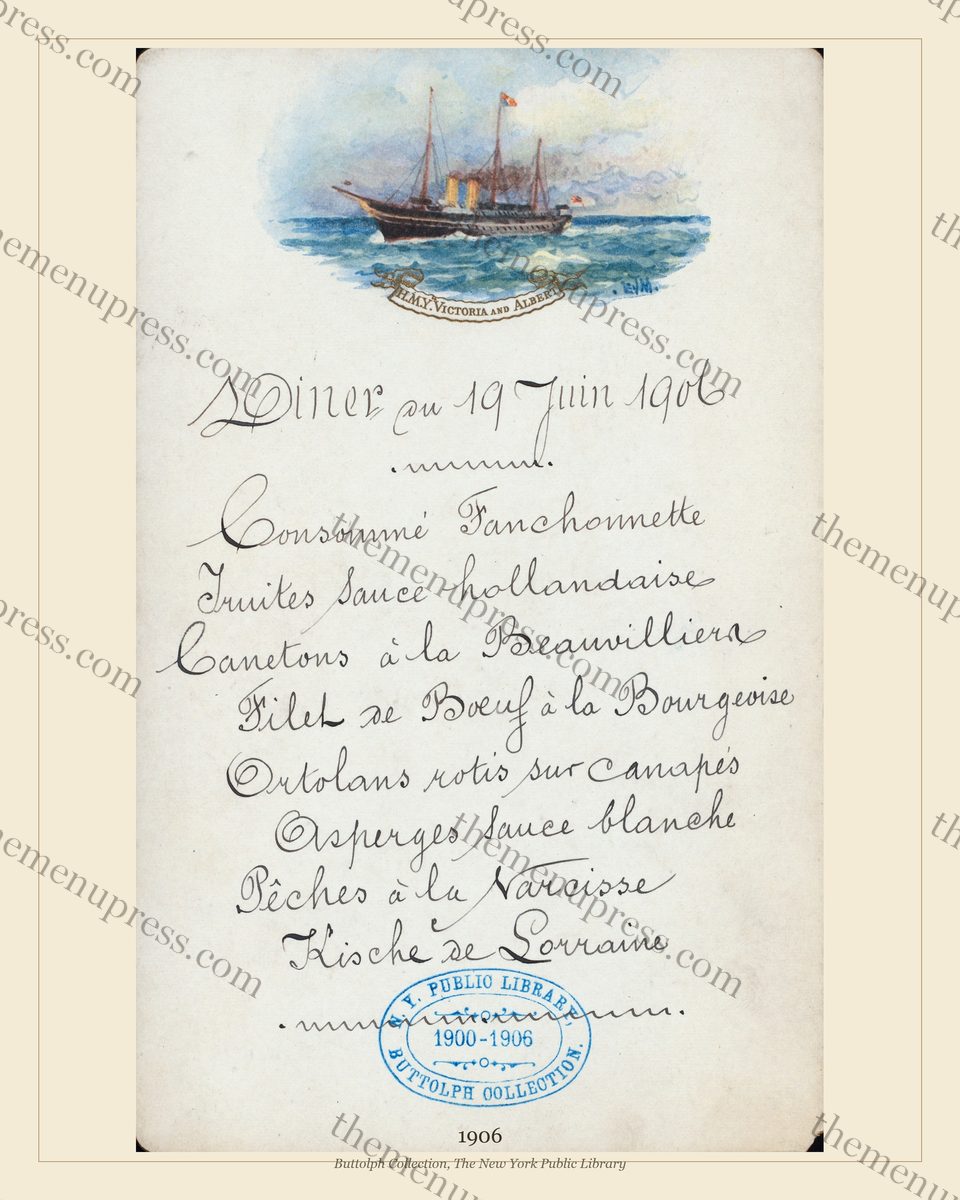
The archive at The Menu Press is a curated, restored, print-ready selection from the Buttolph holdings. Every card we publish is a single Buttolph item, digitally restored and reformatted at archival quality for use as wall art. The Golden Age of Ocean Liner Menus collection is the densest part of our current archive.
Frequently Asked Questions
Who was Frank E. Buttolph?
Frances E. Buttolph (1850–1924) was a New York Public Library cataloguer who, beginning in 1899, single-handedly built what became the world’s largest archive of historic printed menus. She wrote letters to restaurants, hotels, ocean liners, and dining clubs asking for copies of their menus, and over twenty-five years assembled an archive of approximately 25,000 holdings now preserved at the New York Public Library and digitised into the public domain.
How many menus are in the Buttolph Collection?
Approximately 25,000, dated between 1851 and 1930 with the densest period 1895–1920. The collection includes ocean-liner menus, hotel banquets, railroad dining cards, society and fraternal banquets, royal and state dinners, and a long tail of restaurants, clubs, and tea rooms.
Are the Buttolph Collection menus in the public domain?
Yes. The New York Public Library digitised the entire collection in 2010 and released the original works into the public domain in the United States. The Library does not assert copyright in the digital reproductions. Curatorial selection, restoration, and editorial work performed by third parties on the Library’s source scans — including The Menu Press — are independently copyrighted.
Where can I see the original collection in person?
The physical material is housed in the Stephen A. Schwarzman Building (the main New York Public Library building) on Fifth Avenue and 42nd Street in Manhattan. The Library’s manuscripts and rare-books reading room provides scheduled access by appointment.
Why does the Buttolph Collection matter more than other menu archives?
Three reasons: it preserves the middle of menus, not just the decorative covers; it captures ordinary menus, not just the elaborate keepsake cards; and it spans all classes of dining, not only first class. Its closest comparable in scale or scope at any other institution does not exist.
Further Reading
- The Golden Age of Ocean Liner Dining 1880–1930 — the design and dining-history pillar that draws on the Buttolph archive
- How a New York Librarian Built the World’s Largest Menu Archive (scheduled W18 Tue)
- Public Domain Menu Archives Worldwide: A Reference List (scheduled W17 Fri)
- Frank E. Buttolph — Wikipedia biographical entry
- John Maxtone-Graham, The Only Way to Cross (Macmillan, 1972)
- Daniel Finamore & Ghislaine Wood, Ocean Liners: Glamour, Speed, and Style (V&A Publishing, 2017)