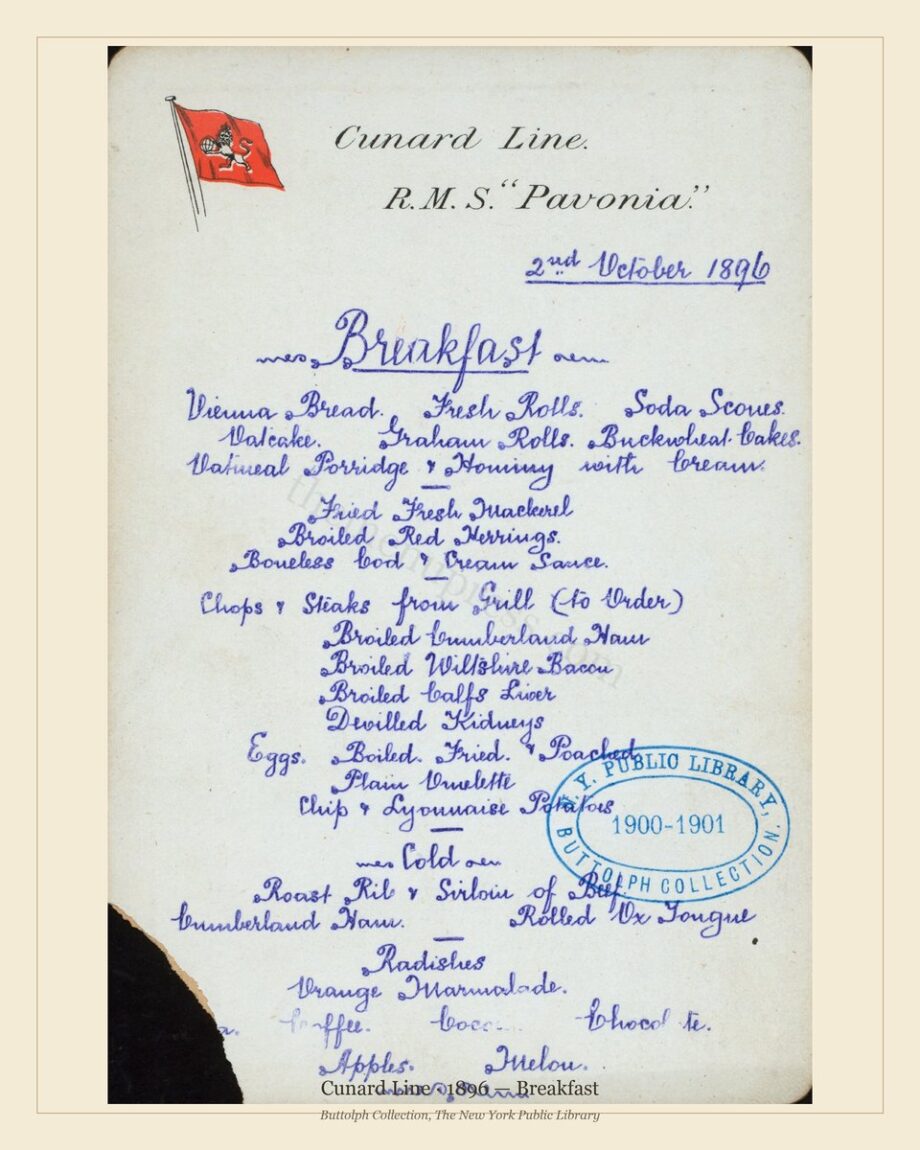
On a February morning in 1896, the Cunard liner Pavonia was steaming east across the North Atlantic. In the first-class dining saloon, stewards were laying out a breakfast that would have impressed any London club. The printed menu survives — and it tells a remarkable story about how the late-Victorian elite started their day at sea.
The ship
The R.M.S. Pavonia was one of Cunard’s slightly older steamers by 1896 — built in 1883, she carried first, second and steerage passengers between Liverpool and Boston. By the standards of the day she was unremarkable, a workhorse rather than a flagship. Yet on board, the dining standards were strict. Cunard had built its reputation on safety, punctuality, and a particular sort of conservative British luxury, and even on a workhorse liner the menus were printed fresh each meal.
What was actually served
The breakfast card from February 1896 reveals a menu that is at once familiar and foreign. Familiar: porridge, eggs, bacon. Foreign: a kind of variety and formality that no modern hotel can match.
Begin with fish: there is fried fillets of cod, almost certainly served with butter and a small wedge of lemon. There are kippered herring, smoked at one of the great east-coast English smokehouses and shipped aboard cold. There is finnan haddie, the Scottish smoke-cured haddock that had become a fixture of British hotel breakfasts since the 1880s.
Then the eggs: poached, boiled, scrambled, fried. Omelette is on the card — almost certainly French in style, three eggs folded around herbs. There is also omelette aux fines herbes specifically, which betrays the influence of French cuisine on what was nominally a British line.
For meats: broiled mutton chops, a Victorian breakfast staple that has almost entirely disappeared. Calf’s liver and bacon. Mutton kidney sauté. These were not unusual — Edwardian England considered offal a vigorous, manly breakfast.
For grains: oatmeal porridge, of course. Hominy — the corn product more commonly associated with the American South, but standard on transatlantic liners because so many passengers were Americans returning home. Cracked wheat.
And finally — a curiosity — buckwheat cakes with maple syrup. The presence of an unmistakably American breakfast on a British ship is a small but striking detail. By 1896, Cunard knew its passenger base. Roughly half of all first-class passengers in any given year were American, and the line had quietly added a few American dishes to its standard menus to keep them happy.
Why this matters
What is most striking, looking at this card 130 years later, is how completely the meal reflects its moment. The Victorian breakfast was substantial, savory, varied — designed for a passenger who would not eat again until a substantial lunch at 1 p.m. and a formal dinner at 7. Coffee, tea, and cocoa were available; iced tea and orange juice were not.
The printed menu itself is small — a single card, perhaps 4 by 6 inches, printed in black ink on cream-coloured stock. There is a wine list on the back, priced in British currency. A small Cunard flag appears at the top: the company’s standard, three balanced horizontal stripes.
This was an object designed to be used once and discarded. Most passengers in 1896 would have set it aside without a thought. A handful, perhaps a collector, perhaps a teenager travelling for the first time, slipped it into a pocket. And so it survived, into the Buttolph Collection of Menus at the New York Public Library, where it sat for a hundred years before we restored it for printing.
About this print
The print we offer is reproduced from the original card. The blue ink stamp at the centre of the menu — added by NYPL when the menu joined the Buttolph Collection — has been carefully removed. The chromolithographic colours and the Edwardian typography have been preserved exactly.