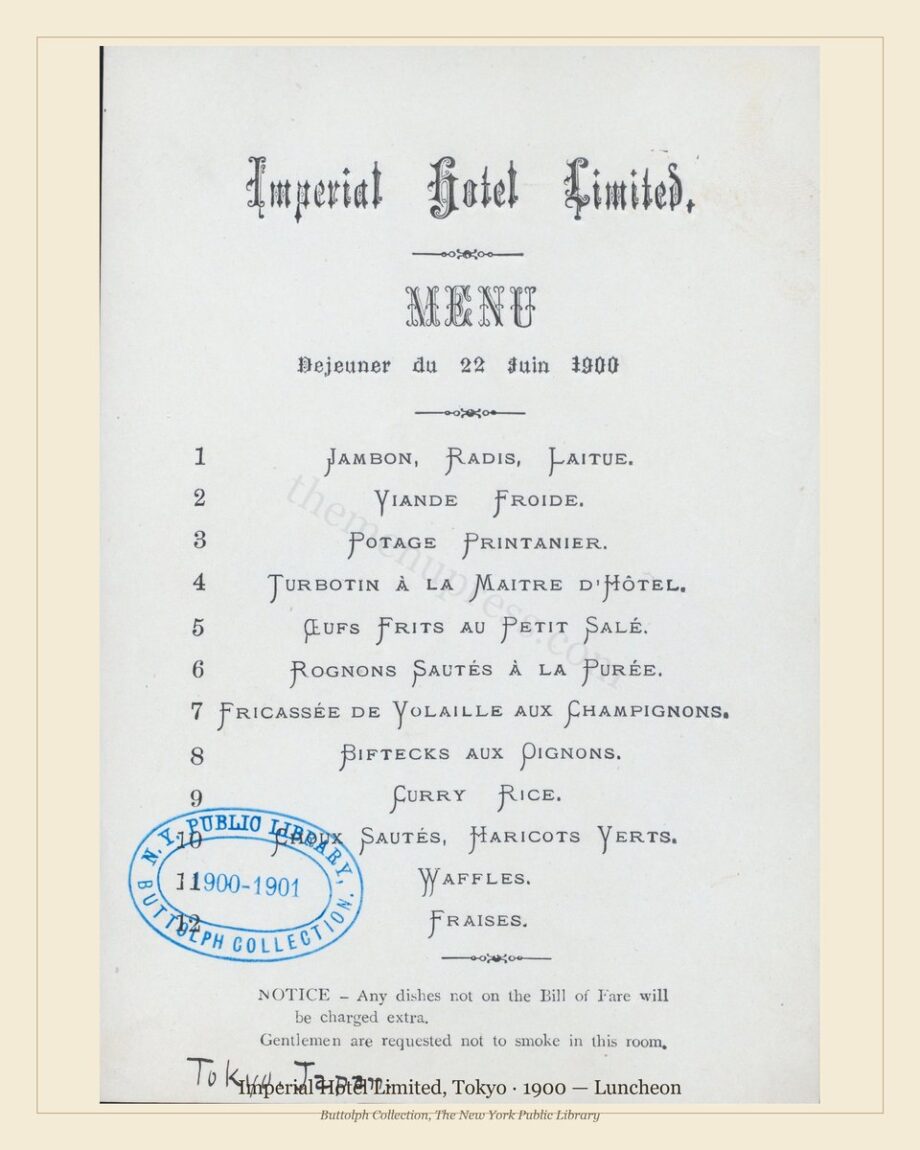
Long before the famous Frank Lloyd Wright building of 1923, the Imperial Hotel of Tokyo was already the meeting point of Imperial Japan and the Western elite. Its printed menus — bilingual in Japanese and English, with delicate typography in two scripts — are a singular category of pre-WWII transpacific ephemera. We have ten of them, dated 1900.
Tokyo’s first international hotel
The original Imperial Hotel (帝国ホテル) opened in November 1890, on a plot of land granted by the Meiji government adjacent to the Imperial Palace. Its founding board included Eichi Shibusawa, the industrialist who would become known as the father of modern Japanese capitalism, and the building was designed to host foreign dignitaries arriving at a Japan that was, at last, formally open to international trade.
From the outset, the hotel was both Japanese and Western. The architecture was European — a German firm provided the original design — but the staff included English-speaking concierges, French-trained chefs, and Japanese kitchen staff who managed the formal Western dining service. By 1900, ten years into the hotel’s operation, the menus reflect this dual identity with extraordinary precision.
The menu
The 1900 dinner menus are printed in two columns, side by side: French on the left (the international diplomatic language of the era), English on the right (the language of international commerce). Sometimes there are kanji or hiragana additions, suggesting that the menus were used at events where Japanese officials and Western visitors dined together.
What was served? The 1900 menus suggest a meal that would have been instantly legible to a Parisian diner of the same year. Consommé, then a fish course (sole, salmon, occasionally turbot — almost certainly imported from cold-water European fisheries), then a meat course (filet de bœuf, agneau, sometimes volaille, sometimes game), salad, cheese, dessert. The wine list, when included, runs the European canon: Bordeaux, Bourgogne, Champagne.
Notably absent from the public menus: Japanese cuisine. The Imperial Hotel of 1900 was a place where Western visitors came to feel that they were in Europe, not in Tokyo. Japanese guests, for their part, came specifically because the dining was Western. Sushi, tempura, sashimi were not what these menus offered. The kitchen handled fish in the French style. This was not a fusion experiment; it was a successful international hotel doing what international hotels did.
Why this matters
What makes these menus historically valuable — and visually striking — is their bilingual typography. Printing French and English side-by-side at letter-press quality was not easy. The Imperial Hotel typesetters managed it. The menus are clean, balanced, perfectly legible. Most have a small printed coat of arms or seal at the top: the chrysanthemum of the Imperial household, occasionally the hotel’s own monogram.
By 1923, when Frank Lloyd Wright’s famously earthquake-resistant Imperial Hotel opened, the menu tradition had evolved into something even more distinctive — and the menus from that era are among the most highly collected pre-WWII Japanese hospitality ephemera. Our 1900 menus precede that famous era, but they are arguably more interesting as a historical document: this is what an international hotel looked like, exactly, when the international hotel was a new idea in Asia.
The print quality
The Buttolph Collection holds ten Imperial Hotel menus from 1900. Each is a single sheet, roughly 4 by 6 inches, with bilingual menus on one side. The paper is cream-coloured; the ink is black with small accent colours. The lithographic quality is high — Tokyo had several first-class printing houses by 1900, and the Imperial Hotel used the best of them.
We have reproduced these menus exactly. The bilingual typography is preserved. The chrysanthemum seal is preserved.
View the Imperial Hotel Tokyo 1900 menu prints → · Browse all Tokyo menus →